Thursday, May 10, 2012

Replacing Heavy Rescue With Lightweight Trailers

Pumpers will tow Rescue Trailers to the scene
(Heavy Rescues to be shut down and sold)

by: Lou Angeli

Wilmington, DE (May 11 2012) -- On January 1, 2011, the lone career Heavy Rescue in the State of Delaware was disbanded by the Wilmington (DE) Fire Department, and 17 jobs eliminated, in an effort to cut “tough times” spending in the state's largest city. At that time, the technical rescue mission was handed over to 2 of the city’s Engine Companies (Engine 1 and Engine 3), which were renamed Squads. During a rescue response, the Squad’s 4-person crew would split up, with 2 firefighters staffing the Engine and 2 responding with a Heavy Rescue.

A few weeks ago, an arbitrator ruled that the Wilmington Fire Department's Squad program  violated its contract with IAFF Local 1590 (Wilmington Firefighters) specifically a clause dealing with 4-person Minimum Staffing. The arbitrator instructed the Fire Department to staff every apparatus with 4 firefighters.

In a somewhat bizarre effort to meet the arbitrator’s demand, the Fire Administration has proposed purchasing three (3) 18-foot trailers, which would carry rescue and haz-mat equipment to incident scenes by towing them behind the existing Squad Pumpers (Squads 1 and 3) and the Haz-Mat pumper (Engine 6). The city says that such a change would allow the 4-person crew to remain together on a common apparatus, while at the same time carrying the tools needed for technical rescue.

Fire administration supports their decision saying that the use of pumper-trailers by fire suppression units is “a popular trend” among the nation’s departments. It is true that the concept of using trailers to haul specialty equipment has been around for several years now, however the towing vehicle is never a pumper with a ball hitch, but rather a dedicated vehicle like a Ford F-550 or even a small 5th wheel tractor.

View samples of emergency service trailers nationwide

For the past few days, Wilmington’s firefighters have been walking around their stations as if a huge question mark had been stamped on their foreheads. The decision is not popular among Wilmington’s rank and file, and comments from fire officials nationally leave dozens of questions unanswered.

 Pumper as Prime Mover?

The most common question among many responders is whether Wilmington’s Pierce pumpers were designed to pull 7 tons of trailer and equipment.

”You’re going to have all sorts of mechanical issues with the proposed idea,” says a retired Battalion Chief with the FDNY. “You need air assist breaks, a chassis and frame designed for towing, beefier suspension and tires to take the load.”

An Illinois Fire Chief comments, “They’ll (also) need a trailer which is designed to carry several tons of equipment, one with heavy duty suspension, and  adequate breaking system and a sturdy frame.”

According to a Pennsylvania manufacturer of similar trailers, “We build these for
construction contractors and landscape companies.” He adds, “They were never designed to serve in an emergency scenario.”

The use of a lightweight trailer has practical drawbacks as well. There is no compartmentalization, interior shelving or ability to mount equipment to the walls. The inability to drop a supply line from a hydrant limits the team’s firefighting power to the 500 gallons of water carried aboard the pumper’s tank. 

During a motor vehicle accident -- the city's most common non-fire rescue response -- rescue tools, like the Jaws of Life, will no longer be pre installed as they are on Heavy Rescue units. The jaws, cutters, spreaders and power plant will need to be retrieved from the trailer, set up and tested, thus delaying the rescue operation.

If you Google "fire pumper with trailer" http://tinyurl.com/8xs8qkc you won't find a single image of a fire pumper with a trailer. You will however find plenty of purpose-built trailers manufactured by companies, which specialize in fire-rescue equipment. You'll also note that they are towed by dedicated prime-movers or towing vehicles.

Incredibly, the most obvious solution to arbitrator's demand seems to escape the mayor and his staff. That answer sits in one of the city’s fire stations – an apparatus which the city already owns -- Rescue-1. Staff it and the city and fire department will be spared the consequences of operating a dangerous system, which has no track record.

 Wilmington's answer: An apparatus which they own!

####


Saturday, April 21, 2012

Historic Friends School Heavily Damaged

 by: Lou Angeli

Wilmington, DE (April 17, 2012) -- A major fire at one of America's oldest schools destroyed an auditorium and damaged other sections of the historic facility. There were no serious injuries but the windswept 3 alarm fire caused damages in excess of $1 million.

Talleyville Fire Company (Station 25) was dispatched for an alarm sounding responding with Quint 257. Back at the school teachers and maintenance staff found that there was indeed a fire, calling 9-1-1 with the additional information. New Castle County Fireboard upgraded the call to a full Box Alarm assignment as well as adding a RIT Team and ALS units.

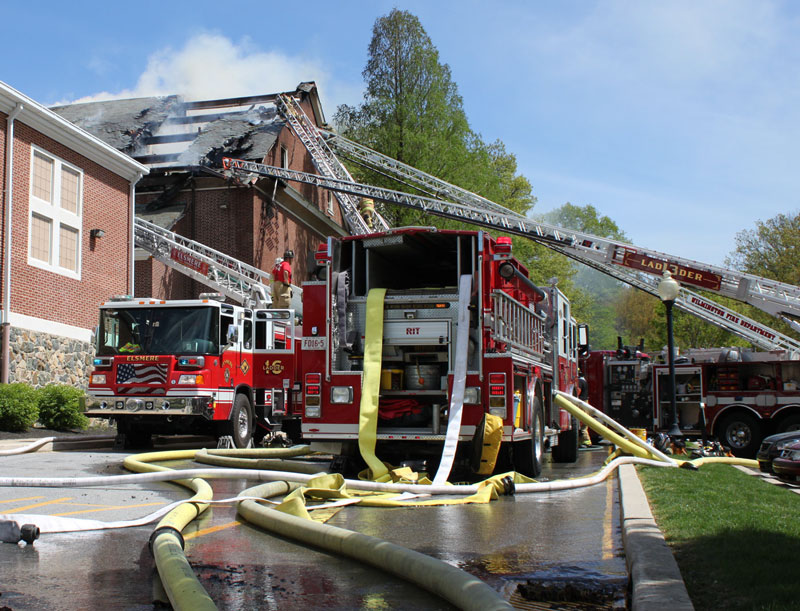
On arrival, Quint 257 found heavy smoke rolling from the roof of the 4 story brick auditorium, part of a complex of connected structures. Talleyville firefighters made their way into the building with a hoseline searching for the source of the blaze. Outside, the aerial ladder was raised quickly in order to give firefighters access to the roof to cut vent holes. Using K12, chainsaws and hand tools, the roof team was unable to cut through slate and copper roofing material. 

"The heat was tremendous," one firefighter said. "I thought my boots were melting."

The 3-man team was ordered off the roof and not one second too soon. Once they had reached the aerial, heavy smoke and flame vented through the roof at the position where they had been standing just moments before.

Arrival conditions: Quint 257 and Engine 253

Talleyville Chief Tom Looney immediately radioed for a 2nd alarm, which included companies from Pennsylvania and the Wilmington Fire Department, Delaware's only career fire-rescue agency. New Castle County EMS responded to provide ALS coverage for fire-rescue personnel. 

As first alarm companies continued to arrive, ladder trucks and towers were positioned at sides A, B and D. Elsmere Ladder-16, Claymont Ladder 13 and Wilmington Ladder-1 joined Quint 257 setting up along the A side while each was fitted with a water supply line in the event that the fire attack became defensive. Tower-11 was assigned to the D side with Ladder-18 covering the B-C side. A collapse sector was established as a precaution.

A firefighter climbs Ladder 13's aerial early in the firefight.

The blaze was difficult to fight. Command was presented with a windowless, brick building with a roof which had been covered with copper and topped of with slate shingles. Inside, non-trussed, thick wooden beams hung high above the audience area making access difficult and providing the fire with plenty of fuel. Winds were gusting to 40mph blowing smoke over North Wilmington and into New Jersey. The roof began to burn with a vengeance.

With collapse eminent, Chief Looney ordered the evacuation of interior personnel and requested a 3rd alarm. The operation evolved into an aggressive exterior attack using elevated master streams from the pre-positioned ladder apparatus.

Engine 165 laid 5" supply line to feed Ladder-16

After nearly 3 hours, the fire was placed under control with many of the companies still working as they checked for hot spots and hidden fire. 2 firefighters were treated by New Castle County Paramedics, then transferred to nearby hospitals for examination. The Delaware State Fire Marshall's office is continuing their investigation.
comments: lou_angeli@comcast.net
All photographs:
(c)2012, Lou Angeli, All Rights Reserved 
###

Monday, April 09, 2012

2 Philly Firefighters Killed in Massive Warehouse Fire

                                                                                                                  photo by: Joseph Kaczmarek/AP

Ladder-10 Officer and Firefighter Killed During Collapse

Philadelphia (CNN) -- Two Philadelphia firefighters died early Monday and three others were injured when the wall of a building collapsed as they battled a five-alarm fire, officials said.

The collapse occurred about 5:50 a.m. as the five were inside a furniture store, said Deputy Fire Commissioner Ernest Hargett Jr.

Four of the firefighters were trapped inside, he said, but the fifth was able to get free. Firefighters were forced to move brick and timber by hand and cut through some materials to rescue the others, Hargett said.

The initial report of the blaze came in at 3:13 a.m., Hargett said. Command requested four additional alarms as the flames burned out of control for two hours and embers set surrounding buildings ablaze.

The firefighters who died were 60 and 25 years old and assigned to Kensington's Ladder-10, Fire Commissioner Lloyd Ayers said. "We have a veteran firefighter and we have a new firefighter," he told reporters. The firefighters' names will be released later Monday, officials said.

The last time multiple Philadelphia firefighters died in the line of duty was 2004, Ayers said, and the last firefighter death was in 2006. The cause of the fire was under investigation Monday, Ayers said.

###

Friday, April 06, 2012

Fire-Rescue-EMS News via LexisNexus and News Aggregators


OPINION

Wilmington, DE (April 6, 2012) -- It's been a busy week for volunteer firefighters in New Castle County, Delaware, and fire departments across the nation have learned the details thanks to software known as a news aggregator. In this case, the automatic system discovered the terms firefighters, structure fire, injured firefighter on DelawareOnline, the web version of Delaware's News-Journal.

These aggregators make life easy for news editors (TV, radio, print and the web) providing stories and features that may be of interest to specific demographic audiences. A prime example exists right here, FirefighterNation.com. Several times each day -- or based on a pre-determined delivery schedule -- news aggregators from major newspapers, wire services and TV stations update fire-rescue news headlines, automatically publishing a story before a site editor has an opportunity to review. Back in the day, these were known as rip and read stories, with the announcer going on the air without ever having previewed the story. Although the idea is similar, the current process is completed electronically in nanoseconds.

Here on my blog, I use the GOOGLE aggregator which sends stories to my email address, and allows me to post or pull.                                                          This is my aggregator section-->>>

Even though it's a Godsend to editors of fire-rescue-EMS websites -- often times those of us who are subjects of a story are thrown under the bus, often being ridiculed by our peers and citizens we protect. Admittedly, there are times, for example when a firefighter is found guilty of arson, that the story is accurate -- simply reporting a statement of fact. Unfortunately, other feeds come from the dregs of the earth -- the yellow journalists. Dennis Smith is cringing because he was not only a firefighter advocate but the consummate journalist.

Last week, The New York Post, long known for its disdain of firefighters, paramedics and law enforcement officers, ran a story with the following headline. "FDNY Retiree Works for NASCAR Fire Crew While Collecting City Disability Pension." The headline writers at the Post are well trained, knowing that if they include terms like FDNY, NASCAR and Fire Crew the news aggregators will kick into action forwarding the story to sites like Fire-Rescue-1, Firefighter Nation, Firehouse.com, and hundreds of others. I've been told by adding NASCAR to the title, the story was distributed to thousands of other sites -- mostly country music radio station websites.

I was horrified when I saw that so many fire-rescue sites ran the story, because as a journalist I instantly recognized that the piece was riddled with inaccuracies and fabrications. The paper boasts that they've exposed a hero firefighter, claiming that he asked for a disability pension so he could volunteer as a NASCAR firefighter. Unfortunately, many firefighters and citizens take the Post's false allegations as gospel truth because they aren't savvy to such journalistic tricks or, more importantly, aware of how the disability system works.

The firefighter accused, once assigned to Rescue Company 3, had served at Ground Zero for months determined to bring the brothers home. We know that to be true by simply confirming the story with others. Unfortunately, during his time on the pile, the firefighter sustained long term injuries and the department called him in for testing. Physicians recommended that he be retired and so ruled the Disability Board. One day he was assigned to one of the great Rescue Companies in the USA...the next he's sitting at home at the kitchen table sipping on coffee.
I suspect the Post maintains hard and fast rules regarding release on medical disability. Sitting on the front porch in a rocker is acceptable -- sharing your knowledge through teaching is not. When you retire, is your plan to sit in a wheel chair, watch the flat screen until you flatline?

The conditions of employment with the FDNY are clear, with one of the most important being able to do the job without causing injury to yourself or endangering fellow firefighters. That's what happened to the Rescue-3 firefighter, like thousands of others who were put to pasture in 2002. And like his colleagues the respected member of Rescue 3 had no intention of leaving the job as he was looking forward to having his own command someday. The events of 9/11 changed so many lives, but in particular veteran firefighters of the FDNY.

Without citing specifics or naming names, I've checked with attorneys and the Manhattan Prosecutor's office and firefighters who have been released on disability have done nothing whatsoever to break the law.

"The system was in place long before he took his oath" one attorney said. "If there's a problem, it's not with the firefighter...it's with the pension system."

Of course, what I've just noted in these previous paragraphs were never included in the NY Post story. Why would they? As I mentioned earlier, the writer is tasked to develop a story based on the headline -- not by truth and accuracy. And it's that headline that places sites like Firehouse.com on my "never return to list." (No reflection on you Chief Eisner)

In all honesty, I must give props to Fire-Rescue-1 because not long after the original Post story appeared, senior editor Rick Markley asked me to post my OP ED onto FR1's online edition. Here on FirefighterNation I posted the same OP ED, once again with positive results. Guess what? Firehouse.com wouldn't allow me to post -- but they did allow our brother firefighters to respond to the NY Post article. That's when I became disgusted and angered.

Here's a sample of responses which appear on Firehouse.com.

Reader: "You can talk all about this crap about being assigned to Rescue 3 for FDNY (so what?). The guy is a piece of sh!t and should be in jail."

Reader: "Not all fireman abide by the honesty creedo.......there are alot of public safety personnel that are in these jobs to see what they can get for themselves."

Reader: "Let's not kiss this guy's ass because he was a fireman. There are no SAINT's riding on any fire trucks in this country. This guy deserves to lose his disability."

None of the responses listed here are informed. I asked the individuals via email to site some of the specifics from the story and as I suspected they could not. Their entire opinion regarding Firefighter Cliff Stabner was formed based on what an aggregator told them -- the story's headline.

I urge the major Fire-Rescue websites and the dozens of excellent emergency services bloggers, to keep an eye on their aggregator feeds. Stories about the convicted arsonist need to be shared so other departments can learn how to weed out the stray member. But to publish a one-sided, factually incorrect story isn't fair to Cliff Stabner -- nor the remainder of us who ride the jumpseat for a living or as an avocation.


Your comments are invited.


___________


Monday, April 02, 2012

NY Post Continues to Defame FDNY Hero

Lewes, DE (April 2, 2012) -- Cliff Stabner has done nothing wrong! He is a former soldier, law enforcement officer and NY City EMT. As a firefighter he was assigned to the most prestigious firefighting unit in North America, FDNY's Rescue-1. The New York Post has this information on hand, but won't reveal it because it doesn't support their comical headline. 
"Disability Duplicity" 
 Who says there are no second acts in American lives? FDNY pensioner Cliff Stabner retired as a “disabled” city smoke eater in 2003 and — presto chango — is now working as an emergency responder . . . at a NASCAR speedway in Delaware.  New York Post Editorial
Like thousands of others rescuers, Cliff was injured at Ground Zero and in 2002 placed on disability by CITY physicians and a CITY board. He never requested to be taken off the job! Why would he? His life was the FDNY. The Post suggests he hired his own attorney to petition for his dismissal, which is a fabricated notion.

To be quite honest, I'm the only person with actual hard evidence of Cliff's role at the speedway. Pictures. I'm a photographer who covers many of the races at Dover and I have specifically covered Cliff -- and the infield safety crew -- in the past. I have never seen him run onto the track to rescue trapped drivers. I learned that as a VOLUNTEER, he drives a utility truck which carries rescue tools, but is mostly involved in training other firefighters and rescue personnel.

Everyone is entitled to their own opinion in this matter, therefore my comments won't include attacks on individual posters. However, to those of you who sit in the easy chair passing judgement on a good man based on a story that the Post never attempted to confirm -- I urge you to take a few moments and perhaps do a little research of your own.

If you're going to serve as Judge and Jury, conduct a proper investigation. I believe that you will find that without a doubt, the problem is with the system -- not Cliff Stabner. Apparently, politicians have been aware of the problem for years, because as the Post noted last Tuesday, "The controversial new pension law approved by Gov. Cuomo and the state Legislature slashes disability pensions for new firefighters by 50 percent."

On September 11, 2001, Cliff Stabner was an American hero -- assisting in the rescue of Captain Jay Jonas, the crew of Ladder 6 and a civilian who were trapped in a collapsed stairway of the North Tower. Today, the law firm known as the New York Post -- always known for their editorial acumen and honesty -- steals a family's good name without ever confirming the source of their tip.
 
###

Saturday, March 31, 2012

New York Post: Discrediting Firefighters Whenever Possible

by: Lou Angeli

Lewes, DE (March 27, 2012) -- I don't know where to start, but first allow me to make this personal statement. The New York Post, one of America's largest newspapers, is also one of its worst. It serves up yellow journalism on a daily basis and "...is best used to line the bottom of bird cages."

Yesterday, Monday March 26, 2012, The Post ran a story about a former FDNY firefighter, who the paper claims faked a medical condition in order to retire early and collect a disability pension. For the sake of this discussion we'll refer to the firefighter as Ray. This news piece hit home here in the First State, because not only is the story a total fabrication of the lifestyle and activities of a fellow Delaware volunteer, but the venerable NY Post lifted one of my photos, one that I shot 2 years ago, to illustrate a story on Track Safety at Dover International Speedway.


For the record, I been photographing firefighting and firefighters for 30 years, and those who know me understand that I would never allow any image or video clip to be used to disparage a firefighter, paramedic, EMT or law enforcement officer. Indeed, I never signed a license allowing the newspaper to use the photo -- and I instructed the writer NOT TO USE IT on three separate recorded telephone conversations.

Ray is a former FDNY firefighter who had a sterling career, so much so that officers of Rescue-1 (Manhattan) and Rescue-3 (The Bronx) fought over him. He served under Capt. Terry Hatton and learned the ropes from fellow firefighter Joey Angelini, who at 65 continued to hold an honored spot on Rescue-1's rig. But all of that came to an end on September 11, 2001. Hatton, Uncle Joe and most of Rescue-1's crew were lost to the towers that day. Ray was off, but responded from home arriving just before the north tower collapsed.

Although I'm not using the firefighter's true name, many of you will recognize him by his voice. When Jay Jonas, serving as Captain of Ladder 6 on September 11th, reported that he and his crew were trapped but alive, it was the Ray who responded by radio. "We're coming for you brother...We're coming for you." Those nine words remain one of the most chilling radio transmissions from that horrible day.

During Rescue and Recovery, Ray searched for his brothers day-in and day-out, spending many, many weeks on the pile. It was hard work but Ray was determined to bring his colleagues home. His decision to see the mission through had its ramifications though. Ray started suffering from pulmonary ailments and after testing, the city released him from service on disability at just 45 years of age.

Fast forward ten years: Ray, now living in downstate Delaware, became a member of his local volunteer fire company -- not so much to ride the apparatus, but to work with the department's junior members. Imagine the quality of education those kids have received!

Because of his rescue expertise, Ray was asked to serve as a consultant to Dover International Speedway's Track Safety Crew, where he worked with NASCAR safety personnel to come up with the SOPS for the extrication of drivers. During the races, Ray drove the utility truck that carried the rescue tools. But everything about NASCAR is fast, and by the time he would arrive, four other fast response vehicles were on the track with a total of 16 firefighters -- enough manpower to attack a well involved room and contents fire.

It must have been a slow news day for the New York Post yesterday. Working on a single tip from a angry individual who didn't care for Ray, the newsrag ran the following headline "Disabled FDNYer with 95K Pension Now a NASCAR Rescuer." The writer was Creepy Carl, as he's known by some, a Mr. Carl Campanile. One individual who has been following Campanile's career notes, "Carl one time was an idealistic journalist, but after years at the Post he has become nothing but a mindless, brainless robotron who does the bidding for his master Rupert Murdoch."

The story is written in the first person narrative as if Carl knows Ray personally. In reality he's speaking for a single individual who called the paper with a tip -- actually a series of tips, all of which are hearsay.  The tips deal with Ray and Campanile ran with the story because the Post seems to discredit firefighters (and law enforcement) whenever possible.

Campanile claims that Ray "may have received his disability...(because) he was overweight." Well, anyone who knows Ray would never describe him as overweight at 6' 5" and 200 pounds. Just check out the picture that I shot -- and the Post ripped off. Curiously, the information and research regarding Ray comes from a sole source -- a whistleblower claims the journalist. Unfortunately, the whistleblower wouldn't allow the newspaper to release her/his name. Perhaps Campanile should have done a background check on his source before ripping into Ray and ruining his life.

The issue of firefighter salaries, pensions and disability benefits are currently being taken to task by the press, citizens and citizens organizations. But how can one fault Ray? It wasn't his decision to leave the FDNY!  His salary, pension and other benefits were determined before he came on the job. And who could have predicted the events of 9/11 and the long term medical issues suffered by tens of thousands of responders? It was the City of New York who gave Ray his walking papers. His preference would have been to remain on the job and work into a command position in special operations. But once a firefighter has been dropped from the roles, there is no appeal process -- no back door to the firehouse.

As for any firefighter or police officer who was forced to retire on disability, what does the Post and unnamed sources of information expect them to do? Sit in a wheelchair in front of the TV? Perhaps have them monitored by webcams 24x7?  Any individual, ill or healthy, should be given the opportunity to pursue a lifestyle that makes them happy, healthy and whole. That's all that Ray wants. And what better way then by serving the community by sharing his incredible knowledge of firefighting and rescue -- whether it's with the young people of Lewes Fire Company, or the Safety Crew at Dover Speedway.

Ray won't be defeated by a nameless accuser that's for sure. He's a Firefighter -- a member of the brotherhood. And if ever a brother needed a lift, Ray is the guy and today is the day.


-------
Photo of "Ray" which was used illegally by the New York Post.  The writer said that "...without the photograph I don't have a story."


comments? louisangeli@yahoo.com


Monday, March 05, 2012

Fire Station Lost To Tornadoes


Milton (KY) Fire-Rescue Station-2 Leveled by Twisters

Milton, KY (March 2, 2012) -- The National Weather Service confirms a EF3 and an EF2 tornado touched down near Milton, Kentucky. Fire chief Jason Long's dash cam video captured the moment he arrived at Milton  fire station 2 only to find it destroyed. 2 firefighters rode out the tornado in the men's room of the firehouse

The lone fire engine at station 2 took a beating and though the winds walloped every inch, it seems to be no match for the spirit in Milton. "When it rained and hailed they were putting flags up there," says Vicki McQueary. "We will make it through this. We will rebuild."

Video from Chief Long's dash cam can be found on CNN at:
 http://ireport.cnn.com/docs/DOC-757516

The Department needs to replace the engine and equipment that was housed in Station 2, including a fish fryer trailer which generates most of the department's income for the year. If you can help, contact Chief Long through the department's Facebook page http://www.facebook.com/pages/Milton-Fire-Rescue/105322572843196

------

Minquadale Firefighters Welcome Their NEW Ride

Rescue-Engine 22

Minquadale, DE (March 1, 2012) -- This 2012 Pierce Velocity/PUC is now in service with the Minquadale Fire Company of New Castle County, DE. It will soon become one of the busiest rescues in the State of Delaware, with the department protecting I-95, I-295, I-495 and US Route 13 in addition to mutual aid response both south and north of the city.

For the members of Station 22, this is a landmark occasion. This Pierce is the first NEW apparatus that they've purchased in 20 years. The company also received delivery of a new Type-1 ambulance on a Dodge chassis.

Congratulations.
Website:  http://www.mfc22.com/

photos by: Lou Angeli

Tuesday, February 07, 2012

Truckies Come Home!


Emphasis on Rolling Stock -- Not Tactics

 by: Lou Angeli

 St. Louis, MO ) - Ever since Neil Svetanics, former Chief of the St. Louis Fire Department, popularized the "Quint Concept" 20 years ago, the nation's fire departments have gone crazy for quints. The concept that some said was a only a passing fad is still claiming new ground.

Admittedly, I'm a big buff, the perennial kid when it comes to firetrucks. But ever since March's FDIC Exhibit, with its hundreds of apparatus and machines on display, many fire officers are beginning to question where we're going -- and why.

At issue here is not the motive of fire apparatus manufacturers, the machines they build, nor their cost. After all, firefighting machines are no longer bought off the lot. We design them ourselves -- every nook and cranny -- from the ground up. But the concern for many is that in the year 2012, too much emphasis is placed on rolling stock and not enough on solid tactics.

In Neil Svetanics case, history shows that his original reason for developing the Quint was more an issue of STAFFING rather than MACHINE. When he assumed command of STLFD, members were operating what could best be described as ancient apparatus with bare bones staffing. It was a department in distress, where three-man engines and two-man ladders were the norm. So, the Quint concept was originally born out of a manning deficiency, and for Svetanics the long term plan was to enhance staffing, not limit it.

It was the late 1980's, and the fire service was begging for new ideas to increase efficiency and use existing manpower more effectively. Needless to say, Svetanics and his idea were at the right place at the right time. But some administrators abused Neil's original game plan, and Svetanics had unwittingly provided them with a way to reduce manning, in the guise of some new nationally recognized procedure.
  
Flexible Response 

Unfortunately, the "kid" in many of us didn't look beyond the red and chrome of those original LTI 75 footers. In fact, very few of us knew the real reason why St. Louis had initiated the Quint Concept in the first place. Many of us were blinded by the originality of this new fangled machine and the importance of the Truck or Support Company was lost in the smoke.

St. Louis dubbed their new SOP "Flexible Response", a procedure that did away with the traditional notion of Engine and Truck Companies. In essence, Neil Svetanics bucked tradition in a big way, and that's not necessarily all that bad. But in the rush to emulate St. Louis' success, many departments ordered up quintuple rigs without a solid plan as to how they were to be used on the field of streams. And that's my hand you see raised, because I sat on the apparatus committee of my own department, when we recommended the purchase a Quint.

Even after we signed the contract, and the rig was online in Wisconsin, our committee still wasn't sure how they quints would be used. As an Engine with an aerial device? Or a Ladder with a pump?

Would it be the first responding machine, or the second-out piece? And most importantly, what would be the crew assignments in a volunteer organization where manning on the rig might fluctuate from three (during the day) to eight (at night).


 A Return To Basics:

In a recent article by John Mittendorf, the former LA City Battalion Chief took his exacto knife to flexible response, and cut the Quint concept to shreads. A bold response by a seasoned fire officer to a procedure that he felt was making the fire attack less efficient and more dangerous.

Mittendorf suggests that the introduction of Quint operations has caused us to neglect a very important fireground function - Truck or Support Company operations. Many believe he's right. The Engine Company cannot mount a fire attack, without the coordinated efforts of the Truck or Support Company. And that's where Quint operations fall short. Because as a first responding rig, the emphasis is exclusively on engine work.

So, before we begin making plans to build another Quint, let's step back and examine why Truck Companies were developed in the first place.

Although aerial ladders and towers exist in the fire service worldwide, the Ladder "Company" itself is a concept that is specific to North America. The origin of the Hook and Ladder Co. goes back to the early volunteer brigades of the 1700's. Back then, H&L members were responsible for separating the fuel from the blaze, and were often closest to the fire. Because they carried ground ladders, they were undeniably an integral part of the rescue operation.

While members of the pumper crews worked with the bucket brigades to fill pumps and extinguish the blaze, the Ladder Company performed all other necessary duties. Today, the Ladder Co. still serves much the same purpose, although dozens of generations have refined this multi-purpose job. But no where else in the World is the distinction between Engine and Truck members so clear-cut as it is in the USA and Canada.

As new tools and equipment are introduced, chances are they end up on the Aerial Apparatus. But how many more compartments can we fill? And at what point does the Ladder Apparatus become a burden, rather than an asset?

Examine the American LaFrance Tractor-Drawn aerial of just 25 years ago. Most equipment was carried in open bins and a few lockable compartments. The rig was lightweight, perhaps a GVW of 40,000 lbs, and could be maneuvered easily through streets and roadways. Its cost in 1974, $150,000.

But at $750,000 to $999,000, today's aerial apparatus have become Land Yachts. Most are built with six and eight man cabs, that rarely see more than four firefighters. Add a 1500 gpm pumps and 500 gallons of H2O, plus hoseline, and the NFPA allows us to call them Quints. They are the Carnival Cruise Ships of the fire service, which are used for every type of emergency -- from EMS to nuisance fires.


Many agree with former Battalion Chief John Mittendorf. The focus they say should be on the traditional function of the aerial apparatus and its crew.

Remember -- Even if your department doesn't operate a Ladder apparatus, the Truck Company function still must be addressed. In part two of this series, we'll examine the importance of the Support Company, and how some departments have enhanced their programs with the addition of Squads, Ladder Tenders, and even an old stand-by, the Quad.

updated 2/7/2012


Saturday, January 14, 2012

Italian Cruise Ship Capsizes on Sandbar

 3 are confirmed dead -- possibly 70 missing after Costa Concordia runs aground along Italian coast.

Wednesday, January 11, 2012

Haiti: 2 Years Later

HD Video clips of the dire situation in Haiti just 36 hours following the massive earthquake that shook Port-Au- Prince to pieces. Now, 2 years later, the debris has been removed from the streets, but the people still live in make shift shanty and tent cities. They are tired, malnourished, and tens of thousands remain ill and injured.


Top 10 Fire-Rescue-EMS Photos of 2011


From massive earthquakes to the nation's most damaging tornado season ever, 2011 proved to be one for the records for those of us who work in the Emergency Services. Here are photos of the Top-10 worldwide disasters for Twenty Eleven. (Top 10 Photos)

Friday, November 11, 2011

KME To Build 21 Pumpers for Philadelphia

In its largest apparatus order in a decade, the Philadelphia Fire Department has contracted with KME Kovatch to manufacture a total of 21 1500gpm pumpers on the new severe service chassis. Delivery is expected to continue through 2012.

Thursday, October 20, 2011

Saving Firefighter Ryan

Learning to Recognize Flashover


by: Lou Angeli

Flashover! Even though firefighters are beginning to understand it, this fatal phenomenon is still shrouded in a veil of mystery. Experts in the fire training arena have differing opinions and descriptions of Flashover, but they all seem to agree on one thing. It's a nasty thing!

Simply put, room and contents begin to burn at a very rapid rate during the growth stage of the blaze. Heat is radiated from burning combustibles, then reradiated by the walls and other structural elements. This "thermal feedback" causes an even greater acceleration of heat. Finally, the entire room and its contents ignite with violent and explosive force.Our culture and its technology have served as a major contributor to the problem of flashover.

Up until the 1960's, the average residence contained natural products made up of woods, cottons and other fabrics. Back then it often took a blaze from 8 to 10 minutes to grow from inception to the fully-involved stage. But in our present day world of synthetics, plastics and hydrocarbons, the same room takes only 2 to 3 minutes to reach the peak of fire growth. This accelerated rate of burn has become a major concern for firefighting teams and the officers who command them.

Oddly enough, it was a prevention tool designed to save lives that first brought Flashover to our attention - the home smoke detector. In days gone by, fires were typically unreported until they vented from a window, sending the fastest civilian running for the Gamewell Box.

Today, because of the effectiveness of early warning systems, departments are now notified of fires much, much earlier.Companies now arrive on the scene during the growth stage, entering the structure at the worst possible time, just prior to flashover. Combine this with the standing practice of aggressive interior attack, and one can quickly understand why firefighters have become more aware, and much more concerned, of the phenomenon.

The simple fact is - we're seeing Flashover conditions much more often.


Low Tech System - High Tech Results

In Europe, where line of duty deaths, and interior attack, are quite rare, the multi-national fire community was shocked, when in 1987, two Swedish firefighters lost their lives to a flashover incident.

In response, training officers in Stockholm saw the need to create an awareness program for the brigade's firefighters. They developed a rudimentary simulator that allows attack teams to identify potentially dangerous environments during the early stages of the firefight. Their primary goal: to demonstrate to suppression teams how to escape a flashover and exit safely.

On the fire training grounds near Stockholm, I prepare to videotape the special fire training simulator designed by the Swedes. I was expecting a high-tech block structure, with thermal sensors, gas jets, and emergency sprinklers. Instead, I'm led to a series of overseas shipping containers, that have been laid out in random fashion to represent various firefighting scenarios.

According to Roland Lindquist, Director of the Raddnings Verket, (The Swedish Fire Rescue Services Board) the system was adopted by all departments in Sweden by 1990. Instructors there further refined both classroom and hands-on curriculum, and today every Swedish firefighter is required to take this special training course. It's dubbed the Swede Survival System, and it's taken Europe, and this nation, by storm.

6,000 miles away from Stockholm, in America's heartland, Indianapolis firefighters carry on a tradition that's been passed down from generation to generation -- mounting an aggressive interior attack. Like so many departments nationwide, Indy fire administration have armed all front-line personnel with the very best in protective equipment. A secure envelope, that guards firefighters from intense heat and vicious flames.

But some say that this very same envelope denies firefighters the use of an important God-given safety regulator – the sense of feel. In short, present day protective gear is so damned good, it's difficult to determine when to bail out.

A 3-alarm blaze in Indy's downtown section, found three firefighters deep inside the bowels of the beast. A huge structure, the Athletic Club blaze was stubborn, and difficult to ventilate. According to other interior personnel, the trio entered a smoky room in search of the seat of the fire, but within moments the room erupted in an explosion of flame, instantly snuffing out their lives.

IFD was determined to prevent similar horrible accidents from ever happening again. They imported the Swede Survival System, and since its installation, EVERY IFD firefighter and officer has received extensive flashover training. Many, more than once.

In other departments throughout the USA, training officers have adapted the system to meet the needs of America's aggressive firefighters. Their goal, to show an uncontrolled blaze in a SAFE, controlled atmosphere. And to date, nearly fifty departments and agencies have answered the call.

----


(1) Swede Survival Systems (Drager Safety)


Copyright 2011, Lou Angeli, All Rights Reserved


The New View from Ten House


For so many years, firefighters at FDNY Station-10 were reminded of 9/11/01 by the giant hole that stood just 50 yards from their station. Today, the view is much different, and although we will NEVER FORGET what happened, the new view from Ten House reveals what Americans do following horror and disaster -- they rebuild. Thanks to all of the trade unions for taking One World Trade to the 75th Floor in time for the 10th Anniversary.

###

Sunday, September 25, 2011

Ladder-1 Wilmington (DE)

Wilmington (DE) Ladder-1 - A 2007 Pierce 100ft TDA -- operating at a 2-alarm residential fire in the city's north side. Heat index was 118F and all firefighters were sent to REHAB for evaluation after 20 minutes. Ladder 1 is housed with Squrt 4 at Station-4.

photo by: Lou Angeli

Friday, June 24, 2011

New Delivery: Rescue-23, Minquaas Fire Company


New Delivery: This 2011 Pierce Heavy Rescue is now in service with the Minquas Fire Company, Station 23, of Newport, Delaware. Rescue-23 and its crew see a great deal of action on the heavily congested section of Interstate 95, which runs through northern Delaware.

###

Thursday, June 16, 2011

New Critical Care Ambulances for Nemours


Nemours forms In-House Critical Care Transport Team

Wilmington, DE (June 16, 2011) -- Nemours Kids Transport, operating from A.I. duPont Hospital for Children in Wilmington, DE, has taken delivery of three 2011 Ford/Horton Type III ambulances. Following stocking and a 4 state inspection tour, these new ambulances will serve with AIDHC's newly-formed critical care transport team. AI hospital will be the third in the Wilmington area to transition to an in-house team with purpose-built equipment. St Francis Hospital operates the BLS system for the city of Wilmington, with Christiana Care operating transport and CC units both at Christiana and Wilmington Hospitals.

###

Wednesday, May 25, 2011

Devastation as far as the Eye Can See

Joplin's Deadly Tornado

Joplin, MO (May 24, 2011) -- I'm a former Missourian and returning to Joplin is bittersweet. I had done some EMS training at St. John's Healthcare and my son lives nearby. Today, I had the opportunity to embed with Missouri USAR Task Force-1 our of Columbia. The last time I saw many of these Firefighters, Medics and Volunteers was during the rescue & recovery at Ground Zero in NYC.

But there was no discussion about the World Trade Center nor other past jobs. Today's focus was on finding victims and recovering of bodies at the Home Depot Store on E. 20th Street - Joplin's OWN Ground Zero from Sunday evening's EF5 Tornado.

During the Wedge-shaped multi-vortex twister, many shoppers sought refuge along the concrete walls that lined the front of the store. They would have been much better off laying low in the open center of the structure. Hammered by 200 + Mile Per Hour winds, the concrete facades quickly failed and fell inward crushing those who believed the walls would block the force of the winds and flying debris.

Yesterday morning, Missouri Task Force-1 - operating with 70 Rescuers - took on the grim job of removing smashed concrete in order to recover the dead. The operation included about 10 large Cat Backhoes with grapplers, a scene reminiscent of New York's Ground Zero.

Once the concrete had been moved, four canine search teams began the job of walking through the debris in order to determine specific locations of the dead and missing. They did so alone, without their handlers - and they did it quickly.

Today brings a similar task - searching a near-by Walmat* Store, which was filled with shoppers when the tornado ripped into the free-standing building.

Although the number of missing is a closely guarded secret, I was told by CNN's Anderson Cooper that it is near 1,500. Now, not everyone unaccounted for is dead - some may be living with relatives, others may likely not have thought to check in with authorities. But the death toll will rise nonetheless.

My helmet is off to FEMA's Director Craig Fugate, whose experience on the front lines, is the trait that makes him stand alone, head and shoulders above all previous FEMA Directors combined. As a Paramedic and former Firefighter, Fugate understands the need for immediate response.

In fact, FEMA personnel had boots on the ground in Joplin within 12 hours of the tragic disaster, and Fugate himself was not far behind. Earlier in the day, I watched as he helped move debris to find a family's pet - alive!!

As always, the brightest part of this story is the incredible turnout of individuals - everyday citizens - who have taken it upon themselves to help feed, clothe and house those who have lost everything. I've always believed that the human spirit is filled with an endless well of good - and during situations like this disaster in Joplin, what has poured from this well makes me proud to be an American.

###

Friday, May 06, 2011

Electing Fire Officers

Is there a better way?


by: Lou Angeli

Suburban Philadelphia, PA -- (November 22,, 2010)  During the next 6 weeks thousands of suburban firefirefighters around metro Philadelphia will have the opportunity to decide who will lead their volunteer department during the year 2011. For nearly 200 years, they will determine by 'popular vote', who is best suited to command the department, which protects a community of tens of thousands and has a budget in the millions.

Of course, the civilian population isn't aware how the department is actually operated. In fact, most assume that their department is staffed by "career" personnel, because of the high level of training and professionalism exhibited by most volunteers at emergencies.

But does it make sense to "elect" emergency management, without regard to qualifications or experience? No. But the fact is that America's most dangerous avocation is sometimes run by individuals who have neither the qualifications or skills to lead a fire department or rescue agency.

As I was browsing through posts on a popular fire and rescue discussion forum the other evening, I was shocked to read that a familiar contributor had resigned from his own department. Why? Because his department's members had elected chief officers with a total combined fireground experience of five (5) years.

Jason Zigmont, content provider for VolunteerFD.org, found that the election process is a pain the axe nationwide. He says that volunteer officers should be held to the same standards as any ‘active’ firefighter. But in many departments, those seeking office may only have 2 years of training and even less experience.

In my former department in Missouri, the annual election of fireline officers had become somewhat of a joke. Those who were vying for the top job began lobbying as early as mid-summer by throwing barbeques and pool parties. By October, morale became a major concern as members split up to support "their man" or "woman.". And without fail, the individual most qualified to lead the department, would lose out to the guy with the nicest lake house.

As I look through my screen into cyberspace, I see that there are those of you who are reading this with a puzzled look. It's for real California! It's how most volunteer departments on the East Coast still operate. A century ago, when these very same departments protected communities of 200 or so, the system worked. But today, operating even the smallest of departments is like running any business. And the folks who run the department need to be more than just brave firefighters. They’re dealing with large budgets, dwindling staffing, a broader variety of emergency incidents and a very demanding general public.

When it comes to the 'election' of individuals to serve in a department's 'administrative' positions, such as a Board Member or Recording Secretary, open voting carries a valid argument. After all, it's how we run our own government. But when it comes to choosing fireground command, or any line officer's position for that matter, the decision must never be based on popularity.

But how do you change the system? It isn’t easy, because no one wants to serve on that committee. In many cases it's extremely difficult to alter the by-laws of a “fire company" or "sub chapter S corporation" because it usually takes a 2/3 vote to override or change existing by-laws.

In nearby Kennett Square, PA, the volunteer fire department did away with the popular vote over 10 years ago, replacing it with a Board of Fire Commissioners, who promote Commanders and Line Officers based on resumes submitted for their review. Administrative management is still elected by the general membership, but the operation of emergency incidents now falls in the hands of qualified, seasoned personnel.

In the 1700's, Ben Franklin helped create the volunteer system to replace the Insurance Brigade system, which had become a failure in Franklin's eyes. 300 years later we're still working from the game plan he scratched on the table at a riverfront pub. I don't think ole’ Ben would object to us making a few play changes here and there.

###