Wednesday, May 22, 2013

Wilmington DE Fire Chief now carrying a firearm


 Chief Anthony Goode

Wilmington Fire Chief Anthony Goode has been carrying a firearm for about a month, saying with increased code enforcement duties he and the mayor’s staff thought he should protect himself.

“Firefighters are always in dangerous situations. You never know what you’re going to be walking into,” Goode said, who was appointed fire chief by Mayor Dennis P. Williams in January.


Goode has been involved in several high-profile code enforcement actions over the past two months, including cracking down on three makeshift clubs run by the Thunderguards Motorcycle Club. While the city’s fire marshals also carry weapons, Goode said his decision to carry will not lead to all Wilmington firefighters arming themselves.

Read the entire story on DelawareOnline.com


###

Tuesday, May 21, 2013

Update from Moore, Oklahoma


Moore, OK (May 21, 2013) -- Firefighters here in Moore are at a premium, so many of the rescue teams are made up of law enforcement, citizen volunteers and off duty medics from the other side of the state. FEMA has a term that it uses to describe volunteers and self responders -- SCUVs. aka Spontaneous Convergent Unaffiliated Volunteers. In rescue circles SCUV is a dirty name but here in Moore the acronym SCUV has been replaced by the term HERO.

Over 100 rescues were made during the night -- many more made this morning. The fire department here in Moore, OK is not very large, but every member is on the scene. There is no off-duty today for them or a thousand other firefighters and rescue personnel who have arrived from Oklahoma, Texas and Missouri. A pair of firefighters wearing FDNY leather made their way to this "pile" in a gesture of repayment for OK's response to the events of 9/11/01.

Law enforcement officers from as far away as Tulsa and Texas are here as well, serving in twin roles today. Their usual job of keeping the peace -- and that of victim rescuer. Many of the first responders lost their own homes, and one I spoke to has a severely injured child who is being treated in Oklahoma City. But they are here doing what they have been trained to do. 


###

Monday, May 20, 2013

Massive Tornado Stikes Moore, Oklahoma

Highway Patrol: "Hundreds and hundreds possibly trapped"

Moore OK (May 20, 2013) -- Moments ago, a massive tornado ripped through the town of Moore, Oklahoma, just outside Oklahoma City — laying waste in its path and killing at least two victims.

"Children trapped---children hurt" at Briarwood Elementary School in Moore, OK after tornado.  

 KFOR meteorologist Mike Morgan just called this "the worst tornado damage-wise in the history of the world." Morgan estimates the damage to be two-three times worse than that of the May 1999 tornado — the worst ever — which also hit the town of Moore.

Now: 49 of the 75 trapped hildren have now been rescued at elementary school however the Moore Regional Hospital is destroyed. Radio traffic: Firefighters are awaiting EMS units to transport injured kids to Childrens Hospital of Oklahoma in OK City.

Cecil County - Ladder-4


Northeast Fire Company's LADDER-4 captured during Newark, Delaware's 2013 Memorial Day Parade. Ladder 4 is a 2009 Seagrave Marauder II 100ft rear mount aerial and covers the central section of Cecil County, Maryland.

photo: Lou Angeli

Dallas Firefighter Killed Following MAYDAY Transmission


 DALLAS (AP) — A firefighter's body was recovered Monday several hours after he called for help because he was trapped in a condominium complex blaze.

Dallas Fire-Rescue spokesman Jason Evans did not immediately release the name of the man, whose body was pulled from the rubble after a frantic, hours long search during the six-alarm blaze in northeast Dallas.

"From where they thought the firefighter was there was pretty much an assembly line of debris, coming where guys were just handing back debris," Evans said.

The fire was reported shortly before 3 a.m. Monday at the three-story condo complex, Evans said. A U.S. flag covered the firefighter's body when it was located and removed.

Two firefighters were transported to a hospital with injuries that were not believed to be life-threatening. Five residents were rescued from the fire and two were treated for minor smoke inhalation, Evans said.

Authorities are trying to determine what sparked the fire, Evans said.

He declined to release details about the firefighter's call for assistance, saying it was a very sensitive matter to victim's family and to the department.

"It's not something that you'd want to hear, you'd want to forget it," Evans said, at times choking back tears during a news conference.

----

Full coverage at FirefighterNation 

Sunday, May 05, 2013

Local Bank Purchases Ontario EMS Choppers


by Lou Angeli

WILMINGTON, DE (May 3, 2013) -- Delaware's Wilmington Trust Company has purchased 2 never-used AW139 Helicopters from Ontario's Medevac provider ORNGE for a cool $10 million per ship. In fact, the 2 choppers (like me) never made it across the Canadian border and were stored at the AgustaWestland's facility in North Philadelphia for over 2 years. 

 Wilmington Trust holds the note on Ornge's fleet of 12 AW helicopters, and some say the term "purchase" should read "repossessed" considering the medevac provider was given a year to sell the choppers but were unable to do so. In fact, the 2 surplus AW139's were never outfitted for EMS use and were fitted as corporate aircraft.

Read the backstory and learn how ORNGE came very close to being grounded.

###

Tuesday, April 23, 2013

Kennett Fire Company -- New Delivery


New Delivery: Congrats to my friends at Kennett Fire Company (Station 24) Kennett Square, PA. The Department has taken delivery of a 2013 Kenworth/US Tanker 3000 gallon Stainless Steel tanker. The chassis is a KW-T800 with 500 HP Cummins power plant. The pump is a Hale QMAX 2000 gpm pump. Check out the department's VERY unique apparatus on their website: http://www.firestation24.com/

Apparatus of the Day, April 23, 2013


Apparatus of the Day: Engine-20, Holloway Terrace Fire Company, New Castle County, DE
2005 -E-One Glider Kit. Additional information at the department's website.

photo by: Lou Angeli

Tuesday, January 22, 2013

Extreme Weather Firefighting


When the goin' gets tough -- the tough get goin' !
by: Lou Angeli

 As weather experts debate the effects of global warming on North American weather patterns, the "B" shift members of St. Louis Squad-2 don't really give a damn. Winter is on them, and the simple fact of the matter is it's getting cold.

Cold weather makes America's most dangerous occupation even more hazardous. Statistics show that most serious fires occur during the winter months, when homes and businesses are sealed tight, and supplemental sources of heat are being used.

Granted, a few areas of North America are "temperate" and experience consistent weather patterns throughout the year. But unless you're a firefighter in Key West, McAllen (TX) or Phoenix, chances are you've already noticed that hot, muggy days have been replaced by cold, windy nights. And fighting fires in below freezing weather isn't fun.

This year, winter came early, and with vengeance to the Prairie Midwest. With temperatures hitting the single digits, and wind chills exceeding minus 40 below, serious fires have caused millions in damage, and claimed a number of lives.

Fighting fires in cold weather is part of everyday life for firefighters in the upper Midwest. And what they’ve learned is that this constant exposure to Mother Nature's brutal side has made on thing clear. The cold takes it toll - on personnel and equipment.
    
 During the next few weeks, the Arctic cold will dip well into the continental US. And even though we know it's likely to happen, Old Man Winter takes those of us in the lower-48 by surprise every time. 

 But It's A Dry Cold, Chief
 
Try telling that to firefighters in Indianapolis, who are accustomed to relatively stable winter weather. Last year by mid-December, they were operating in the coldest air to hit the area since 1887. Just South of Indy, in Bargersville, Indiana, the town experienced 12 consecutive days of sub-zero weather. Years of training and experience hadn't prepared these Johnson County firemen for this type of firefighting.

 
Generally speaking, North of the Mason-Dixon line, departments are better prepared for the hardships of cold weather. But when the alarm sounds, and the thermometer is stuck at zero, neither a firefighter's training or protective gear can block out the effects of the biting cold. So how do firefighters in Minneapolis, Green Bay and Chicago deal with the cold? Many have developed a contingency plan - one that stresses "firefighter safety".

Using Common Sense

Once on the fireground, firefighter safety becomes a primary consideration for command. While Engine Company members concern themselves with fighting the fire inside the structure, ladder and support company members are busy fighting the elements, working on slippery surfaces and icy ladders.

Firefighting in cold weather still requires getting water to handlines and master streams and moving H2O is one of the most difficult tasks in winter firefighting. In icy temperatures, leading off from a frozen hydrant or pond may waste valuable minutes. That's why it's important to pre-plan wintertime water supply operations.
 
In Porter County, Indiana, members of Center Fire & Rescue rely on large diameter supply lines and tanker shuttles to provide adequate water. Planning officers know that it's difficult enough to secure water under ideal situations. But when the weather turns cold, the job becomes much more difficult. So they've preplanned for the worse case scenario, matching mutual aid companies with their own resources to get the job done. Mutual Aid also plays a vital role during "working" assignments, especially when one factors in RIT teams and firefighter rehab.
 
Important Cold Weather Tips

Fighting fires in cold weather isn't only uncomfortable for front line personnel, it's damaging to equipment as well. Here are some tips from departments around the country, that may prove useful during cold weather incidents in your area:
  • Avoid coming up DRY, by initiating a hydrant "Pump-Out" plan
  • Apparatus maintenance is crucial! Make sure that tire chains or other traction devices are available for all first-in units
  • Develop a "contingency plan" with the authority or agency responsible for road maintenance and service
  • Develop SOP's regarding "dry-pump" vs. "wet-pump" operations. Things to consider are response time, pump design and normal ambient temperature in the station.
  • Carry a supply of salt, sand or oil-dry to enhance footing and reduce the possibility of falls
  • During heavy snowfalls, apparatus may be forced to operate "away" from the fire building. Extra lengths of attack line should be added to preconnects to compensate for the additional stretch
  • Following knockdown, when handlines are in standby, partially opened control valves will allow water to flow and prevent freezing.
  • Make sure that all waterways for monitors or deck pipes are dry, to avoid any freezing or clogging effects resulting from ice or slush
  • Follow the manufacturer's recommendations regarding the cold weather use of SCBA. Don't allow water to seep into regulators or emmission valves
  • And finally, ensure that extra turnout gear is available, especially gloves. It's recommended that personnel wear layered clothing, rather than bulky articles.
It’s no secret that ours is a unique profession. We're called upon to perform a number of important time crucial tasks in a wide range of weather conditions. So whether we're working in desert heat - or arctic cold, our mission is always the same. To save the folks inside, and perhaps save their home.

Thursday, January 17, 2013

New Video Training System for Firefighters and EMTs


Wilmington, DE (January 17, 2013) -It's needed -- let's do it! From the producer of the Firehouse Video Training System and contributor to American Heat (that's me) a new short-form video training series for firefighters and EMT's. I've been tossing this idea around for abou...t a year now, but it became a reality today after agreeing on a distribution source.

Need your help to determine topics and choose subject matter experts.

Seeking content partners to help develop this series of 8-12 minute videos dealing with firefighting and EMS basics. Also searching for on-camera presenters. Be assured that the production quality will be first-class and the training information topical and up to date.

If you have an interest in educating First Responders or assisting on camera with hands-on demonstrations, please message me.

louangelidigital@gmail.com

Monday, December 17, 2012

Saving Our Own


"How best could the Sandy Hook Massacre been prevented?"

by: Lou Angeli

Many will take issue with me regarding the following comments -- however I pose the following question: How best could the Sandy Hook Massacre been prevented? 

Consider the following: The weapons were legally purchased by Nancy Lanza, the mother of the shooter. Police report that she owned stash of handguns with extended clips and at least one assault rifle and other long guns. Perhaps a strange cache for a mom, but legal nonetheless. The son, Ryan Lanza -- who most believe was mentally disturbed -- turned the woman's own weapons against her, shooting her down in their shared home.

It's at this point where I lose my gun control friends because they don't get it at all. From the moment he shot his mother, Ryan Lanza's mental condition was no longer a consideration, because he had transitioned into a terrorist. Leaving home, he took his mother's car and drove to the school with one mission -- to take the lives of children and teachers. No one, other than Lanza himself, knew anything about what he planned to do.

It wasn't until Lanza opened fire in the Sandy Hook Elementary School that the first 9-1-1 calls were made to Newtown Police. Radio tapes reveal a very calm, professional dispatcher, who notified immediately notified mutual aid departments and the Connecticut State Police. As the tape continues, the caller at the school reports more shots fired, information which the dispatcher passes on to responding units. Depending on whose timeline you follow the first police officer arrived between 5 to 7 minutes after the first 9-1-1 call. But sadly, by then the children and teachers were shot dead, and the gunman lay on the floor, dead from a self inflicted wound. Reports are that the children had been shot anywhere from 3 to 11 times.

Since Columbine there have been some 30 mass shootings that have taken place here in the states. On a few occasions psychological testing has detected distressed individuals, but many of them showed symptoms and sought help. But neither gun control or testing could have prevented the Newton shootings. In this case, and others like it, the only concrete way to intervene and STOP the massacre was with an equal show of force.

Until some entity comes up with a better idea, we must establish an armed presence at every school, whether it be duty assigned law enforcement, National Guard or a volunteer group made up of teachers, administrators and service employees, who have been trained and licensed to serve in such a role. Before the rhetoric in DC, before the shrinks begin to expound on Freud and Adler, the only viable interim measure is to form immediate response teams who operate within the school, ready to take arms at a moment's notice.

I know I'll be getting my ass ripped on this one. But please consider this. Ask the parents of school children whether they want to wait several generations for gun control to take effect? Or do they prefer to provide their schools with the only clear cut way to deal with a terrorist.


###

Lou Angeli

Thursday, September 27, 2012

Training Chicago Fire's Actors

In anticipation of NBC's new Fire-Rescue-EMS dramatic series "Chicago Fire," I spoke to CFD Deputy District Chief Steve Chikerotis about how the series' acting ensemble is being prepared to perform as firefighters and paramedics.


Firefighting, EMS, the Web and Social Media


Veteran responders: Remember back in the day -- before the internet -- when contact with one another was through print magazines or via "pen pals?" Back then we learned of LODDs, huge incidents, apparatus deliveries and job notifications through magazines like Firehouse, Fire Engineering, Fire Chief, JEMS and monthly regional newspapers.

For example, in the 1980's and early 90's, it might take us months to read about a story like Detroit's major staffing cuts. LODDs were honored 10-12 at a time in the trade magazines, with very little information about the specifics of those deadly incidents. And photos? We only had access to a few images from the largest of incidents. If we wanted to see additional photos, we purchased them from the photographer.

These days there are millions of online images of firefighters, EMTs, medics, apparatus, stations, incidents and more calendar shots than Hooters could ever muster. All free for the viewing. And within moments of a brother or sister dying on the job, notes of condolence and tribute are posted on discussion forums, blogs and, of course, Facebook.

Most importantly, though, we're able to read and view what's happening in departments throughout the world in real time through Twitter, YouTube and sites like Flickr. In addition, there are millions of pages of training and information, SOPs, SOG's, powerpoint presentations and features that allow departments to share valuable research, especially in areas of firefighter and EMT safety.

What are some of your recollections from the past when communicating with one another required a stamp, subscription or long distance phone call?

Lou
 
---------

Monday, August 06, 2012

Quints: Tactical Solution or Cross-Staffing Guise?

St. Louis Engine-8 -- 2nd Generation Quint

Emphasis on Rolling Stock -- Not Tactics

by: Lou Angeli

(St. Louis, MO ) - Ever since Neil Svetanics, former Chief of the St. Louis Fire Department, popularized the "Quint Concept" some 20 years ago, the nation's fire departments have gone crazy for quints. The concept that some said was a only a passing fad is still claiming new ground.

Admittedly, I'm a big buff, the perennial kid when it comes to firetrucks. But ever since March's FDIC Exhibit, with its hundreds of apparatus and machines on display, many fire officers are beginning to question where we're going -- and why.

At issue here is not the motive of fire apparatus manufacturers, the machines they build, nor their cost. After all, firefighting machines are no longer bought off the lot. We design them ourselves -- every nook and cranny -- from the ground up. But the concern for many is that in the year 2012, too much emphasis is placed on rolling stock and not enough on solid tactics.

In Neil Svetanics case, history shows that his original reason for developing the Quint was more an issue of STAFFING rather than MACHINE. When he assumed command of STLFD, members were operating what could best be described as ancient apparatus with bare bones staffing. It was a department in distress, where three-man engines and two-man ladders were the norm. So, the Quint concept was originally born out of a manning deficiency, and for Svetanics the long term plan was to enhance staffing, not limit it.

It was the late 1980's, and the fire service was begging for new ideas to increase efficiency and use existing manpower more effectively. Needless to say, Svetanics and his idea were at the right place at the right time. But some administrators abused Neil's original game plan, and Svetanics had unwittingly provided them with a way to reduce manning, in the guise of some new nationally recognized procedure.

Flexible Response 

Unfortunately, the "kid" in many of us didn't look beyond the red and chrome of those original LTI 75 footers. In fact, very few of us knew the real reason why St. Louis had initiated the Quint Concept in the first place. Many of us were blinded by the originality of this new fangled machine and the importance of the Truck or Support Company was lost in the smoke.

St. Louis dubbed their new SOP "Flexible Response", a procedure that did away with the traditional notion of Engine and Truck Companies. In essence, Neil Svetanics bucked tradition in a big way, and that's not necessarily all that bad. But in the rush to emulate St. Louis' success, many departments ordered up quintuple rigs without a solid plan as to how they were to be used on the field of streams. And that's my hand you see raised, because I sat on the apparatus committee of my own department, when we recommended the purchase a Quint.

Even after we signed the contract, and the rig was online in Wisconsin, our committee still wasn't sure how they quints would be used. As an Engine with an aerial device? Or a Ladder with a pump? Would it be the first responding machine, or the second-out piece? And most importantly, what would be the crew assignments in a volunteer organization where manning on the rig might fluctuate from three (during the day) to eight (at night).

Wilmington (DE) Fire Department -- Ladder Company-1

A Return To Basics:

In a recent article by John Mittendorf, the former LA City Battalion Chief took his exacto knife to flexible response, and cut the Quint concept to shreads. A bold response by a seasoned fire officer to a procedure that he felt was making the fire attack less efficient and more dangerous.

Mittendorf suggests that the introduction of Quint operations has caused us to neglect a very important fireground function - Truck or Support Company operations. Many believe he's right. The Engine Company cannot mount a fire attack, without the coordinated efforts of the Truck or Support Company. And that's where Quint operations fall short. Because as a first responding rig, the emphasis is exclusively on engine work.

So, before we begin making plans to build another Quint, let's step back and examine why Truck Companies were developed in the first place.

Although aerial ladders and towers exist in the fire service worldwide, the Ladder "Company" itself is a concept that is specific to North America. The origin of the Hook and Ladder Co. goes back to the early volunteer brigades of the 1700's. Back then, H&L members were responsible for separating the fuel from the blaze, and were often closest to the fire. Because they carried ground ladders, they were undeniably an integral part of the rescue operation.

While members of the pumper crews worked with the bucket brigades to fill pumps and extinguish the blaze, the Ladder Company performed all other necessary duties. Today, the Ladder Co. still serves much the same purpose, although dozens of generations have refined this multi-mission job. But no where else in the World is the distinction between Engine and Truck members so clear-cut as it is in the USA and Canada.

The $1 Million Quint -- Garden City, PA

As new tools and equipment are introduced, chances are they end up on the Aerial Apparatus. But how many more compartments can we fill? And at what point does the Ladder Apparatus become a burden, rather than an asset?

Examine the American LaFrance Tractor-Drawn aerial of just 25 years ago. Most equipment was carried in open bins and a few lockable compartments. The rig was lightweight, perhaps a GVW of 40,000 lbs, and could be maneuvered easily through streets and roadways. Its cost in 1974, $150,000.

But at $750,000 to $999,000, today's aerial apparatus have become Land Yachts. Most are built with six and eight man cabs, that rarely see more than four firefighters. Add a 1500 gpm pumps and 500 gallons of H2O, plus hoseline, and the NFPA allows us to call them Quints. They are the Carnival Cruise Ships of the fire service, which are used for every type of emergency -- from EMS to nuisance fires.

Many agree with former Battalion Chief John Mittendorf. The focus they say should be on the traditional function of the aerial apparatus and its crew.

Remember -- Even if your department doesn't operate a Ladder apparatus, the Truck Company function still must be addressed. In part two of this series, we'll examine the importance of the Support Company, and how some departments have enhanced their programs with the addition of Squads, Ladder Tenders, and even an old stand-by, the Quad.

###


Saturday, August 04, 2012

Takin' It To The Streets

Tower-Ladder 2 operating at a 3-alarm blaze along the Riverfront

Firefighters and Supporters Must Educate Citizens

Wilmington, DE -- (August 4, 2012) -- There was a time in my life when Fire Departments were set-up to handle worst-case scenarios, but unfortunately those days are long gone. Today, city administrators are content to operate with just enough resources to mitigate a single room and contents fire. They claim that the BIG blazes of the 70's and 80's are a thing of the past. So, they play a numbers game and each time a box alarm is toned out, someone at city hall is shaking his fist and rolling the dice. This drill will continue, with half of the city's current fire-rescue resources, if a certain democratic candidate wins the primary here in Wilmington, Delaware.

The general public isn't privy to this never ending, high stakes crap game.The wager? Their lives and the lives of their families, friends and neighbors. Unless the community wants to see another Scranton or Chester right here in Wilmington, firefighters and firefighter supporters MUST take their important message to the people. Share it on the radio, in the news and go DOOR-TO-DOOR.

William Montgomery -- from Google Images

Drastic cuts to the Fire Department are being recommended by Democratic candidate, William Montgomery, an administrator who is no stranger to cutting firefighters and fire-rescue services. As Mayor Jim Baker's Chief-of-Staff, Montgomery implemented "Rolling Bypass" (closure of an engine company each day) and disbanded the State's ONLY career staffed Heavy Rescue, Rescue Company-1. Montgomery makes no bones about his disdain for firefighters -- and one can assume that a Montgomery administration would bring hard times to Wilmington's Bravest. One plan is to cut the WFD by 50% -- to a 3-Engine, 1-Ladder Department. That would leave 16 firefighters - citywide - to protect a daytime population of 100,000. Another idea places 2 engines out of service, and converts the existing Ladder Companies to multi-purpose Quints.

Montgomery and his mission must be discredited publicly if the Wilmington Fire Department is to remain at its current strength -- 6 engines and 2 ladders -- which is 2 companies short as is. There are just a few weeks remaining until the Democratic primary -- and there a lot of neighborhoods for firefighters to canvas. 

For Wilmington firefighters, this is the MOST IMPORTANT election of their careers. With cutbacks of 50% awaiting Wilmington firefighters, and under a Monty Administration, there will be mass layoffs, dozens of demotions and a once proud department will lay in ruins.

Keep the Wilmington Fire Department a mufti-faceted, well staffed emergency agency -- That's the message that needs to be taken to the streets and shared with the citizens of Wilmington!

Lou Angeli


Sunday, July 29, 2012

Wilmington Firefighters Reveal Political Endorsements

Rep. Dennis P. Williams: Local 1590's choice for mayor.

Wilmington, DE -- Following a closely watched Meet the Candidate's Night, it didn't take long for Wilmington Firefighters (IAFF Local 1590) to decide which contenders they would support in the 2012 elections. Topping the list is Mayoral candidate, Dennis P. Williams, who once worked side-by-side with Wilmington's firefighters as a law enforcement officer, but who for the past few decades has served in the State Legislature as the powerhouse Democrat from District 1, north Wilmington.

Some in the community feel that endorsements from union locals and their representatives have come too early, but the reality is that Wilmington's mayoral election will take place a full two months before the general election in November. Why? There is no substantial Republican opposition, so the Mayor will be selected during the Democratic Primary, which this year falls on September 11th. And with a little over a month until the primary, candidates are rounding the final turn and racing toward a tight finish.

In light of Mr. Williams decision to run on a public safety platform, the Firefighters' endorsement is an important one -- equally as important as that of the Fraternal Order of Police. Because some believe that for the past several years, the current administration has been misleading the citizens of Wilmington when it comes to fire-rescue protection. 
The biggest rub has been that of "Rolling Bypass," more accurately known as brownouts. Each day Rolling Bypass closes one of three city engine companies, leaving the 6 Engine department (see city website) with only 5. Then, 2 years ago, the mayor and his staff (which includes mayoral candidate William Montgomery) ordered the closure of Rescue Company 1, the state's only career staffed rescue unit. (see Wilmington's Rescue-1 Disbanded)  Seventeen firefighters were lost as part of that closure, and one of the state's most valued fire-rescue resources vanished. Net loss: 8 firefighters per shift and with it the inability to handle multi-alarm incidents.

When I interviewed Rep. Williams this past spring, we discussed problems related to fire-rescue at length.
"The day I become mayor,' he insisted, 'I'll order the fire chief to end this rolling bypass nonsense immediately."
When asked about Rescue-1 he was just as insistent.
"Closing Rescue-1 makes no sense at all to me...it's like telling the police department to disband their SWAT unit." He continued. "Since Rescue-1 is an important state resource, my plan is to approach the state to help us re-open that company."
When it comes to state money, Williams knows where it is and how to get it because he heads the Joint Finance Committee. Unlike the current administration, which has done a super job of alienating the Governor and Legislature, Williams connections in Dover run long and run deep.
I applaud Wilmington Firefighters for their decision to endorse Dennis P. Williams as mayor. There is no doubt in my mind that he will restore the department's capabilities and morale to where it was under Chief James Ford. Although I can't speak to the law enforcement side of his campaign, he has released a plan to stem the current rash of shootings -- a plan which is based through consultation and 20 years on the mean streets as a police officer.

As a fire service advocate, the job's been tough these past few years. I've argued positions for Los Angeles, Detroit and Scranton, PA, where firefighters are now working for minimum wage. However, as a Wilmington resident, my advocacy will remain strongest in my hometown. Dennis has my vote -- all I ask Sir, is that I can post some POSITIVE commentaries about the Wilmington Fire Department in the near future.

Lou Angeli


Tuesday, July 03, 2012

Tactical Changes at FDNY?


Bold Change in Firefighting Strategy

Governor's Island, NYC -- The FDNY is considering changes in the way they do business. Research being conducted at Governor's Island reveals that early ventilation endangers firefighters and victims by accelerating fire growth. Another practice being considered, cooling a smoke filled room before the location of the fire is identified. Sounds very much like 3D firefighting.

Read the story published in the New York Times


###

Sunday, June 24, 2012

Hot Fun in the Summertime


SOPs and Protocol for SEVERE HOT Weather Firefighter Rehab
 By Lou Angeli

Simply stated Firefighter Rehab is designed to ensure that the physical and mental well being of members operating at the scene of an emergency (or a training exercise) don't deteriorate to the point where it affects the safety of any other members. After all, "stressed out" is not a good thing when you're working at America's most dangerous job.

Back in 1993, the US Coast Guard conducted a study dealing with the effects of interior firefighting on the human body. The results of the study are posted in the Coast Guard's Firefighting Initiative, but in short, researchers noted that our body core temperature (even for short exposures), often reaches 104 degrees (F) during the firefight.

A multi-alarm blaze: The heat index was 104F
(1) Primary Mission

The primary mission for fire command is to identify, examine and evaluate the physical and mental status of fire-rescue personnel who have been working during the emergency incident or a training exercise. Following a proper survey (see below), it should be determined what additional treatment, if any, may be required.

According to FEMA, "Any activity or incident that is large in size, long in duration, and/or labor intensive will rapidly deplete the energy and strength of personnel and thus merits consideration for rehabilitation."

 2. Launching The Rehab Operation

A specially designated Rehab Area, (or Group) -- remote from the fire or emergency incident -- should be established at the discretion of the Incident Commander in consult with the senior Safety Officer. If the Incident Commander determines that Rehab is necessary, qualified EMT-Ps or EMT-Bs (assigned to the first alarm response) should be assigned to manage the Rehab Sector under the command of a fire or EMS officer or supervisor. Note the emphasis of the "first alarm response."


EMS personnel must be on scene and available to provide treatment to fireground personnel at a moment's notice. If EMS does not respond as part of the initial turnout, consideration should be given to the fact that OSHA will certainly ask why they weren't... especially if anyone is injured.

Because they work side by side with the front line troops, company officers play an important role in Rehab. In fact, the federal government suggests that the safety of the fireground rests here, at the supervisor level. If a company member shows signs of fatigue or illness, the company officer will likely be the first to recognize the problem.

Anticipate Rehab needs early in the incident. During large-scale operations, Incident Command should consider augmenting existing resources by requesting additional EMS personnel or even another engine company or squad, to assist in the operation of the Rehab Sector.


(3) Locating the Rehab Sector

It is crucial for Command to establish The Rehab Sector away from any environmental hazards, or by-products of the fire, such as smoke, gases or fumes. During hot months, the ideal location might include a shady, cool area distant from the incident. In winter, a warm, dry area is preferred.

Regardless of the season, the area should be readily accessible to EMS-Rescue personnel and their equipment, so they may restock the sector with supplies, or in the event that emergency transport is required.

Rehab sites can also be established in the lobbies of nearby buildings, parking facilities, or even inside municipal buses. Misting/cooling systems, heating systems, SCBA refilling and canteen service should be stationed in or around this area as well. During large-scale incidents, like multi-alarm fires, Command should consider establishing Multiple Rehab Areas as the situation warrants.

(4) Coordination and Staffing

Command of the Rehab Area should be assigned to a chief or company level officer, who is designated as the Rehab Officer under most Incident Command structures. The incident itself will determine just how many people you'll need to do the job, however a minimum of two trained EMS personnel should initially be assigned to monitor and assist firefighters in the Rehab Sector. Utilize volunteer canteen or auxiliary members to assist EMS personnel in making "working" members as comfortable as possible.

(5) Evaluation of Fire-Rescue Personnel

 It is important for command and company level officers to continually monitor personnel for telltale signs of exhaustion, stress, and or physical injury. Individual members are encouraged to report to the Rehab Sector at any time that he or she feels the need to do so. Symptoms may include weakness, dizziness, chest pain, muscle cramps, nausea, altered mental status, difficulty breathing, and others. Regardless of physical well being, all fireground personnel should report to the Rehab Sector immediately following.

- Strenuous Activity
- Forcible Entry, Advancing Hoselines, Ventilation, etc
- The use and depletion of two SCBA bottles
- Thirty (30) minutes of operation within a hazardous/dangerous environment

- Failure of SCBA

 (6) Examination of Personnel

Arriving personnel should be examined by qualified EMS personnel, who should check and evaluate vital signs, and make proper disposition, i.e. return to duty, continued rehabilitation, or transport to medical facility for treatment. The workup should include:

- Scoring for Glasgow trauma scale.
- Checking Pupils
- Checking Vital Signs, such as blood pressure, pulse, breathing rate
- Checking lung sounds
- Administration of a 2-lead EKG, when chest pain or irregular heartbeat is presented
- Skin condition and color Body core temperature


- Heart rate should be measured as early as possible in the rest period.
If the firefighter's heart rate exceeds 110 beats per minute, it is recommended that an oral temperature be taken. If body core temperature exceeds 100.6F, the firefighter should not be permitted to wear protective equipment or re-enter the active work environment, until temperature has been reduced and heart rate decreased.
It is recommended that re-examination occur at ten minute intervals. Using standing orders or existing protocol, Rehab Team Members should record examination results on medical evaluation forms as indicated by the local jurisdiction.
(7) Treatment During Rehab
Upon completing the physical examination, the following steps should be taken to minimize further risk to fire-rescue personnel: Turnout gear, helmets, masks and hoods should be removed immediately. Prior to ingesting anything orally, fluid or solid, it is recommended that the firefighter clean his/her hands and face with water and a cleaning agent, as provided by Rehab Sector personnel.

- The firefighter should rehydrate
- Oral re-hydration and nutrition is recommended in the form of 1-2 quarts of fluids
- Body core temperature should be reduced by cooling the body
- Cool body temperatures gradually using misting systems, fans, etc
- Individuals should be offered Oxygen therapy via nasal cannula or O2 mask.


The firefighter will only report to manpower staging when presentation is deemed normal by the attending EMS personnel. Note: According to FEMA and the NFPA, Water is the best re hydration agent, however some agencies suggest a re hydration solution of 50 / 50 mixture of water and a commercially prepared activity beverage administered at about 40F. Avoid cooling the body using ice packs or hose streams. Cooling should be gradual, limiting further shock to the body.


In the event that presentation appears abnormal, the Firefighter should immediately receive additional treatment, especially if conditions persist following fifteen minutes of rest. As is appropriate in most locales, those complaining of chest pain, difficulty breathing and altered mental status must receive immediate ALS treatment and transport to definitive health care. Follow your local jurisdiction's ALS protocols in this event.

 
 (8) Accountability

Members reporting to the Rehab Sector / Group should enter and exit the Area as a team. Their company designation, number of personnel, and the times of entry to and exit from the Rehab Area should be documented. This can be done either by the Rehab Officer or his / her designee on a Company Check-In / Out Sheet. Keep crews together, and don't allow overanxious members to freelance the event.

 (9) The Vital Importance Of Firefighter Rehab

Very few firefighters who wear the badge are athletes. But, from the moment the alarm is sounded, and that first surge of adrenaline reaches the heart, we're asking our bodies to work triple overtime. Couple that with 55 pounds of business suit, 1200 degree temperatures and another 50 pounds of hand tools and equipment, and the importance of effective rehabilitation at the fire scene becomes crystal clear. Make it part of your command strategy.

------

Originally published in Fire Chief Magazine -- written by Lou Angeli

For written copies contact Lou at lou_angeli@comcast.net


Thursday, May 10, 2012

Replacing Heavy Rescue With Lightweight Trailers

Pumpers will tow Rescue Trailers to the scene
(Heavy Rescues to be shut down and sold)

by: Lou Angeli

Wilmington, DE (May 11 2012) -- On January 1, 2011, the lone career Heavy Rescue in the State of Delaware was disbanded by the Wilmington (DE) Fire Department, and 17 jobs eliminated, in an effort to cut “tough times” spending in the state's largest city. At that time, the technical rescue mission was handed over to 2 of the city’s Engine Companies (Engine 1 and Engine 3), which were renamed Squads. During a rescue response, the Squad’s 4-person crew would split up, with 2 firefighters staffing the Engine and 2 responding with a Heavy Rescue.

A few weeks ago, an arbitrator ruled that the Wilmington Fire Department's Squad program  violated its contract with IAFF Local 1590 (Wilmington Firefighters) specifically a clause dealing with 4-person Minimum Staffing. The arbitrator instructed the Fire Department to staff every apparatus with 4 firefighters.

In a somewhat bizarre effort to meet the arbitrator’s demand, the Fire Administration has proposed purchasing three (3) 18-foot trailers, which would carry rescue and haz-mat equipment to incident scenes by towing them behind the existing Squad Pumpers (Squads 1 and 3) and the Haz-Mat pumper (Engine 6). The city says that such a change would allow the 4-person crew to remain together on a common apparatus, while at the same time carrying the tools needed for technical rescue.

Fire administration supports their decision saying that the use of pumper-trailers by fire suppression units is “a popular trend” among the nation’s departments. It is true that the concept of using trailers to haul specialty equipment has been around for several years now, however the towing vehicle is never a pumper with a ball hitch, but rather a dedicated vehicle like a Ford F-550 or even a small 5th wheel tractor.

View samples of emergency service trailers nationwide

For the past few days, Wilmington’s firefighters have been walking around their stations as if a huge question mark had been stamped on their foreheads. The decision is not popular among Wilmington’s rank and file, and comments from fire officials nationally leave dozens of questions unanswered.

 Pumper as Prime Mover?

The most common question among many responders is whether Wilmington’s Pierce pumpers were designed to pull 7 tons of trailer and equipment.

”You’re going to have all sorts of mechanical issues with the proposed idea,” says a retired Battalion Chief with the FDNY. “You need air assist breaks, a chassis and frame designed for towing, beefier suspension and tires to take the load.”

An Illinois Fire Chief comments, “They’ll (also) need a trailer which is designed to carry several tons of equipment, one with heavy duty suspension, and  adequate breaking system and a sturdy frame.”

According to a Pennsylvania manufacturer of similar trailers, “We build these for
construction contractors and landscape companies.” He adds, “They were never designed to serve in an emergency scenario.”

The use of a lightweight trailer has practical drawbacks as well. There is no compartmentalization, interior shelving or ability to mount equipment to the walls. The inability to drop a supply line from a hydrant limits the team’s firefighting power to the 500 gallons of water carried aboard the pumper’s tank. 

During a motor vehicle accident -- the city's most common non-fire rescue response -- rescue tools, like the Jaws of Life, will no longer be pre installed as they are on Heavy Rescue units. The jaws, cutters, spreaders and power plant will need to be retrieved from the trailer, set up and tested, thus delaying the rescue operation.

If you Google "fire pumper with trailer" http://tinyurl.com/8xs8qkc you won't find a single image of a fire pumper with a trailer. You will however find plenty of purpose-built trailers manufactured by companies, which specialize in fire-rescue equipment. You'll also note that they are towed by dedicated prime-movers or towing vehicles.

Incredibly, the most obvious solution to arbitrator's demand seems to escape the mayor and his staff. That answer sits in one of the city’s fire stations – an apparatus which the city already owns -- Rescue-1. Staff it and the city and fire department will be spared the consequences of operating a dangerous system, which has no track record.

 Wilmington's answer: An apparatus which they own!

####


Saturday, April 21, 2012

Historic Friends School Heavily Damaged

 by: Lou Angeli

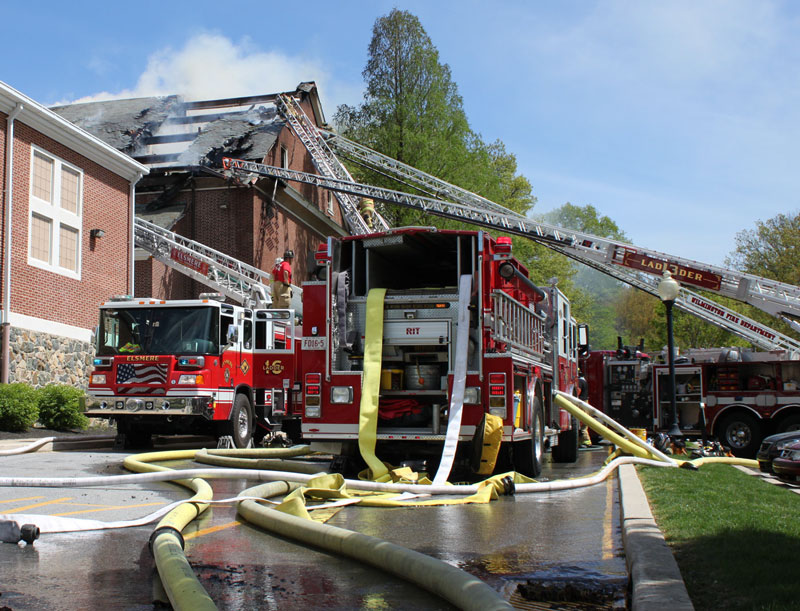
Wilmington, DE (April 17, 2012) -- A major fire at one of America's oldest schools destroyed an auditorium and damaged other sections of the historic facility. There were no serious injuries but the windswept 3 alarm fire caused damages in excess of $1 million.

Talleyville Fire Company (Station 25) was dispatched for an alarm sounding responding with Quint 257. Back at the school teachers and maintenance staff found that there was indeed a fire, calling 9-1-1 with the additional information. New Castle County Fireboard upgraded the call to a full Box Alarm assignment as well as adding a RIT Team and ALS units.

On arrival, Quint 257 found heavy smoke rolling from the roof of the 4 story brick auditorium, part of a complex of connected structures. Talleyville firefighters made their way into the building with a hoseline searching for the source of the blaze. Outside, the aerial ladder was raised quickly in order to give firefighters access to the roof to cut vent holes. Using K12, chainsaws and hand tools, the roof team was unable to cut through slate and copper roofing material. 

"The heat was tremendous," one firefighter said. "I thought my boots were melting."

The 3-man team was ordered off the roof and not one second too soon. Once they had reached the aerial, heavy smoke and flame vented through the roof at the position where they had been standing just moments before.

Arrival conditions: Quint 257 and Engine 253

Talleyville Chief Tom Looney immediately radioed for a 2nd alarm, which included companies from Pennsylvania and the Wilmington Fire Department, Delaware's only career fire-rescue agency. New Castle County EMS responded to provide ALS coverage for fire-rescue personnel. 

As first alarm companies continued to arrive, ladder trucks and towers were positioned at sides A, B and D. Elsmere Ladder-16, Claymont Ladder 13 and Wilmington Ladder-1 joined Quint 257 setting up along the A side while each was fitted with a water supply line in the event that the fire attack became defensive. Tower-11 was assigned to the D side with Ladder-18 covering the B-C side. A collapse sector was established as a precaution.

A firefighter climbs Ladder 13's aerial early in the firefight.

The blaze was difficult to fight. Command was presented with a windowless, brick building with a roof which had been covered with copper and topped of with slate shingles. Inside, non-trussed, thick wooden beams hung high above the audience area making access difficult and providing the fire with plenty of fuel. Winds were gusting to 40mph blowing smoke over North Wilmington and into New Jersey. The roof began to burn with a vengeance.

With collapse eminent, Chief Looney ordered the evacuation of interior personnel and requested a 3rd alarm. The operation evolved into an aggressive exterior attack using elevated master streams from the pre-positioned ladder apparatus.

Engine 165 laid 5" supply line to feed Ladder-16

After nearly 3 hours, the fire was placed under control with many of the companies still working as they checked for hot spots and hidden fire. 2 firefighters were treated by New Castle County Paramedics, then transferred to nearby hospitals for examination. The Delaware State Fire Marshall's office is continuing their investigation.
comments: lou_angeli@comcast.net
All photographs:
(c)2012, Lou Angeli, All Rights Reserved 
###