Joplin's Deadly Tornado
Joplin, MO (May 24, 2011) -- I'm a former Missourian and returning to Joplin is bittersweet. I had done some EMS training at St. John's Healthcare and my son lives nearby. Today, I had the opportunity to embed with Missouri USAR Task Force-1 our of Columbia. The last time I saw many of these Firefighters, Medics and Volunteers was during the rescue & recovery at Ground Zero in NYC.
But there was no discussion about the World Trade Center nor other past jobs. Today's focus was on finding victims and recovering of bodies at the Home Depot Store on E. 20th Street - Joplin's OWN Ground Zero from Sunday evening's EF5 Tornado.
During the Wedge-shaped multi-vortex twister, many shoppers sought refuge along the concrete walls that lined the front of the store. They would have been much better off laying low in the open center of the structure. Hammered by 200 + Mile Per Hour winds, the concrete facades quickly failed and fell inward crushing those who believed the walls would block the force of the winds and flying debris.
Yesterday morning, Missouri Task Force-1 - operating with 70 Rescuers - took on the grim job of removing smashed concrete in order to recover the dead. The operation included about 10 large Cat Backhoes with grapplers, a scene reminiscent of New York's Ground Zero.
Once the concrete had been moved, four canine search teams began the job of walking through the debris in order to determine specific locations of the dead and missing. They did so alone, without their handlers - and they did it quickly.
Today brings a similar task - searching a near-by Walmat* Store, which was filled with shoppers when the tornado ripped into the free-standing building.
Although the number of missing is a closely guarded secret, I was told by CNN's Anderson Cooper that it is near 1,500. Now, not everyone unaccounted for is dead - some may be living with relatives, others may likely not have thought to check in with authorities. But the death toll will rise nonetheless.
My helmet is off to FEMA's Director Craig Fugate, whose experience on the front lines, is the trait that makes him stand alone, head and shoulders above all previous FEMA Directors combined. As a Paramedic and former Firefighter, Fugate understands the need for immediate response.
In fact, FEMA personnel had boots on the ground in Joplin within 12 hours of the tragic disaster, and Fugate himself was not far behind. Earlier in the day, I watched as he helped move debris to find a family's pet - alive!!
As always, the brightest part of this story is the incredible turnout of individuals - everyday citizens - who have taken it upon themselves to help feed, clothe and house those who have lost everything. I've always believed that the human spirit is filled with an endless well of good - and during situations like this disaster in Joplin, what has poured from this well makes me proud to be an American.
###
Commentary on the world's most admired professions by firefighter and filmmaker, Lou Angeli.
Wednesday, May 25, 2011
Friday, May 06, 2011
Electing Fire Officers
Is there a better way?
by: Lou Angeli
Suburban Philadelphia, PA -- (November 22,, 2010) During the next 6 weeks thousands of suburban firefirefighters around metro Philadelphia will have the opportunity to decide who will lead their volunteer department during the year 2011. For nearly 200 years, they will determine by 'popular vote', who is best suited to command the department, which protects a community of tens of thousands and has a budget in the millions.
Of course, the civilian population isn't aware how the department is actually operated. In fact, most assume that their department is staffed by "career" personnel, because of the high level of training and professionalism exhibited by most volunteers at emergencies.
But does it make sense to "elect" emergency management, without regard to qualifications or experience? No. But the fact is that America's most dangerous avocation is sometimes run by individuals who have neither the qualifications or skills to lead a fire department or rescue agency.
As I was browsing through posts on a popular fire and rescue discussion forum the other evening, I was shocked to read that a familiar contributor had resigned from his own department. Why? Because his department's members had elected chief officers with a total combined fireground experience of five (5) years.
Jason Zigmont, content provider for VolunteerFD.org, found that the election process is a pain the axe nationwide. He says that volunteer officers should be held to the same standards as any ‘active’ firefighter. But in many departments, those seeking office may only have 2 years of training and even less experience.
In my former department in Missouri, the annual election of fireline officers had become somewhat of a joke. Those who were vying for the top job began lobbying as early as mid-summer by throwing barbeques and pool parties. By October, morale became a major concern as members split up to support "their man" or "woman.". And without fail, the individual most qualified to lead the department, would lose out to the guy with the nicest lake house.
As I look through my screen into cyberspace, I see that there are those of you who are reading this with a puzzled look. It's for real California! It's how most volunteer departments on the East Coast still operate. A century ago, when these very same departments protected communities of 200 or so, the system worked. But today, operating even the smallest of departments is like running any business. And the folks who run the department need to be more than just brave firefighters. They’re dealing with large budgets, dwindling staffing, a broader variety of emergency incidents and a very demanding general public.
When it comes to the 'election' of individuals to serve in a department's 'administrative' positions, such as a Board Member or Recording Secretary, open voting carries a valid argument. After all, it's how we run our own government. But when it comes to choosing fireground command, or any line officer's position for that matter, the decision must never be based on popularity.
But how do you change the system? It isn’t easy, because no one wants to serve on that committee. In many cases it's extremely difficult to alter the by-laws of a “fire company" or "sub chapter S corporation" because it usually takes a 2/3 vote to override or change existing by-laws.
In nearby Kennett Square, PA, the volunteer fire department did away with the popular vote over 10 years ago, replacing it with a Board of Fire Commissioners, who promote Commanders and Line Officers based on resumes submitted for their review. Administrative management is still elected by the general membership, but the operation of emergency incidents now falls in the hands of qualified, seasoned personnel.
In the 1700's, Ben Franklin helped create the volunteer system to replace the Insurance Brigade system, which had become a failure in Franklin's eyes. 300 years later we're still working from the game plan he scratched on the table at a riverfront pub. I don't think ole’ Ben would object to us making a few play changes here and there.
###
by: Lou Angeli
Suburban Philadelphia, PA -- (November 22,, 2010) During the next 6 weeks thousands of suburban firefirefighters around metro Philadelphia will have the opportunity to decide who will lead their volunteer department during the year 2011. For nearly 200 years, they will determine by 'popular vote', who is best suited to command the department, which protects a community of tens of thousands and has a budget in the millions.
Of course, the civilian population isn't aware how the department is actually operated. In fact, most assume that their department is staffed by "career" personnel, because of the high level of training and professionalism exhibited by most volunteers at emergencies.
But does it make sense to "elect" emergency management, without regard to qualifications or experience? No. But the fact is that America's most dangerous avocation is sometimes run by individuals who have neither the qualifications or skills to lead a fire department or rescue agency.
As I was browsing through posts on a popular fire and rescue discussion forum the other evening, I was shocked to read that a familiar contributor had resigned from his own department. Why? Because his department's members had elected chief officers with a total combined fireground experience of five (5) years.
Jason Zigmont, content provider for VolunteerFD.org, found that the election process is a pain the axe nationwide. He says that volunteer officers should be held to the same standards as any ‘active’ firefighter. But in many departments, those seeking office may only have 2 years of training and even less experience.
In my former department in Missouri, the annual election of fireline officers had become somewhat of a joke. Those who were vying for the top job began lobbying as early as mid-summer by throwing barbeques and pool parties. By October, morale became a major concern as members split up to support "their man" or "woman.". And without fail, the individual most qualified to lead the department, would lose out to the guy with the nicest lake house.
As I look through my screen into cyberspace, I see that there are those of you who are reading this with a puzzled look. It's for real California! It's how most volunteer departments on the East Coast still operate. A century ago, when these very same departments protected communities of 200 or so, the system worked. But today, operating even the smallest of departments is like running any business. And the folks who run the department need to be more than just brave firefighters. They’re dealing with large budgets, dwindling staffing, a broader variety of emergency incidents and a very demanding general public.
When it comes to the 'election' of individuals to serve in a department's 'administrative' positions, such as a Board Member or Recording Secretary, open voting carries a valid argument. After all, it's how we run our own government. But when it comes to choosing fireground command, or any line officer's position for that matter, the decision must never be based on popularity.
But how do you change the system? It isn’t easy, because no one wants to serve on that committee. In many cases it's extremely difficult to alter the by-laws of a “fire company" or "sub chapter S corporation" because it usually takes a 2/3 vote to override or change existing by-laws.
In nearby Kennett Square, PA, the volunteer fire department did away with the popular vote over 10 years ago, replacing it with a Board of Fire Commissioners, who promote Commanders and Line Officers based on resumes submitted for their review. Administrative management is still elected by the general membership, but the operation of emergency incidents now falls in the hands of qualified, seasoned personnel.
In the 1700's, Ben Franklin helped create the volunteer system to replace the Insurance Brigade system, which had become a failure in Franklin's eyes. 300 years later we're still working from the game plan he scratched on the table at a riverfront pub. I don't think ole’ Ben would object to us making a few play changes here and there.
###
Saturday, April 02, 2011
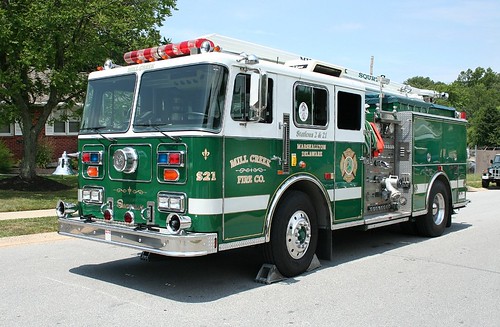
Mill Creek Squrt-21
Painted in Miil Creek "green" Squirt 21 is a 1989 Seagrave 1500 gpm pumper with 750 gallon water tank. It serves as the department's mutual-aid engine. Since 1927 the department's apparatus have carried the green color, adding white over cabs in the 1970's and the safety stripe in the 1990's.
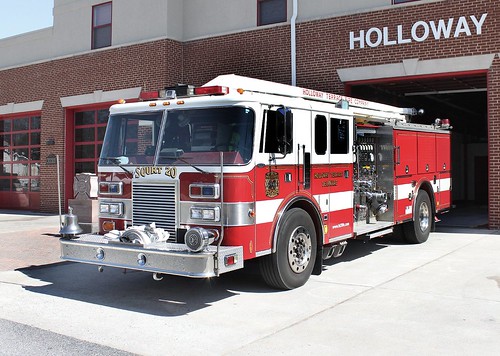
Squrt 20
Squrt 20 is operated by the Holloway Terrace Fire Company of New Castle County, Delaware (USA). The squrt sits atop a Pierce Lance with a 1250gpm pump, 750 gallon water tank and 50 gallons of foam.
Monday, March 14, 2011
Sunday, March 13, 2011
USAID Dispatches USAR Teams To Japan
Washington, DC (March 13, 2011) -- The estimated death toll from Japan's earthquakes, tsunamis and nuclear power plants soared past 10,000 Sunday as authorities raced to combat the threat of multiple nuclear reactor meltdowns. Tens of thousands are missing and hundreds of thousands of people struggled to find food and water.
Two Urban Search and Rescue Teams from the United States are on the ground in Japan and being deployed to the devastated northeastern section of the country. Los Angeles County USAR, just back from deployment in New Zealand, and the Fairfax County VA USAR Teams are being joined by search and rescue teams from around the globe as they search through devastated coastal towns.
The U.S. Agency for International Development (USAID) reports that a Disaster Assistance Response Team (DART) has also been dispatched, along with the California and Virginia teams.
to be updated regularly
Thursday, March 03, 2011
Rolling Bypass: Accuracy in Explaining a Controversial Public Safety Concept
Commentary
by: Lou Angeli
WILMINGTON, DE (March 3, 2011) -- As a resident of Wilmington, Delaware, I am served by one of the best-trained, most experienced fire departments in the nation. I support and have a deep respect for the staff and members, however I am neither a career firefighter nor member of Local 1590, the Wilmington Fire Fighter’s Association.
I have written this commentary in response to the continuing confusion surrounding the Wilmington Fire Department’s “Rolling Bypass Program,” a cost cutting concept, which you may hear referred to as brownouts or blackouts, (1) depending on where you live in the country. The program has cut overtime costs, however it wasn't enough to cover the predicted deficit, and on January 1, 2011, Delaware's only full-time, profesionally staffed Rescue Squad was closed - along with the loss of 17 jobs.
So let's take a moment now to review the WDEL story, which in its print version heralded the following headline:
First, a short backgrounder on the current make up of the Wilmington Fire Department and how Rolling Bypass is used. This is the research part of the story that reporter Amy failed to do.
The Wilmington Fire Department is made up of Engine Companies, Squads and Ladder Companies, along with Battalion shift commanders, all of whom answer to the Deputy Chief of Operations and the Fire Chief.
Companies respond on structure fires, nuisance blazes, automobile accidents, gas leaks, explosions, hazardous materials incidents and life threatening emergency medical calls. Why Medical? Well, if there’s a report of a heart attack, chest pains, a stabbing or shooting, Wilmington Firefighters, trained and certified as EMT’s, can respond quickly to initiate patient care.
As an example, let's consider a scenario in which a resident has suffered a Heart Attack somewhere in the city. As part of a multi-tiered response, the nearest Engine company is dispatched because each company carries an Automatic Defibrillator (AED), which is an essential life-saving tool when dealing with cardiac patients. In a few minutes time, the nearest engine can be on scene, and using the AED, perhaps restore the patient's heart rhythm, before County Paramedics, St Francis BLS and Wilmington Police arrive on scene.
And now for Citizen Firefighting 101 -- and there will be a test!
The Engine Company
The Engine Company is the heart of the firefighting operation. Why? Well, as old school firefighters would say, they put the wet stuff on the red stuff. Each engine is fitted with a large volume pump, water tank, foam, various sizes and lengths of hose and nozzles. Upon arriving at a fire, the engine company members secure a water supply (hydrant) – then prepare to make entry into the fire building to extinguish the blaze
The Ladder Company
The Engine and Ladder Companies work as a Team
When they arrive at the blaze, The Ladder Company’s crew has a much different mission than the Engine crew. Members assigned to the Ladder are responsible for making entry into the building, conducting a search for victims, placing ladders against the building, venting the structure and finally overhaul – the search for hidden fire in walls, roofs and voids.
In order to be effective, the hoseline attack by the engine company must be coordinated with the ventilation effort by the ladder company’s crew. That means that both units – each with very specific jobs -- need to be on the scene together in order to conduct a safe and proper fire attack.
Stations and Locations of Rolling Bypass Companies:
Engine-6 – which shares its quarters with Tower Ladder 2 at 3rd and Union Streets.
Squrt-4 – an Engine equipped with a water tower, which shares quarters with Ladder Company 1 on Tatnall Street near Concord Avenue.
Engine-5 – which operates alone. It serves as the first due company in high value sections of the city including Trolley Square, 40 Acres, Kentmere Parkway, Rockford Park and the Triangle Neighborhood. In addition, most of the city’s elderly high rises are located in Engine 5’ local alarm district.
How does Rolling Bypass impact a firefighting operation? Let’s assume that today Engine 6 – 3rd and Union Street – is in bypass and unstaffed. Even so, the fire station remains open with Tower Ladder 2 staffed by a fire officer and three firefighters.
At 10am, companies are dispatched to a structure fire at a donut shop on Lancaster Ave at Cleveland Avenue in the far western section of the city. On a normal day, Engine 6 and Ladder Tower 2 would respond together, followed by additional engines and 2 battalion chiefs.
However, it’s not a normal day at Station 6, and first-due Tower Ladder 2 leaves its station alone. There are three engines also on the roll, all of which are responding from distant stations. Traffic conditions and speed will determine how quickly they can arrive to assist the crew of the Tower Ladder.
Who's On First?
The Ladder Company arrives and the officer reports that a large section of the rear of the structure is burning with a vengeance. It’s 10:02am, which will serve as the officially recorded arrival time. The crew hears sirens in the distance, but the fire ignores the whines and begins to consume the front of the store. But what course of action can the Ladder officer and his crew take? With no water or hoses, they can only await the arrival of the first engine company. (1)
At roughly the 5-minute mark, Engine Company 5 arrives from their station in the 40 Acres, closely followed by Squad 1, whose crew has responded from 2nd and West streets. Within a minute, 6 firefighters are in position and have begun an aggressive attack. Ladder company members are on the roof, using a chain saws, to create ventilation openings.
And here lies the confusion when different groups -- with vastly different interests -- interpret response data. In order to illustrate to citizens that Rolling Bypass doesn’t affect day-to-day fire-rescue operations, city administrators use the 10:02am mark as the official time of arrival – a response of just 2 minutes. But the actual firefight didn’t begin until 10:06am. That’s a 4-minute difference in opinion, and for firefighters-- and the FIRE -- there is no firefight unless water is streaming from the nozzle of a hose.
The Wilmington Fire Department subscribes to standards and recommendations set by the National Fire Protection Association, a non-governmental watchdog agency, which monitors
firefighting in the United States. One very important standard, NFPA 1710,(3) deals with the operation of a career fire department, like Wilmington's. 1710 describes "arrival time" as the moment when "4 firefighters have assembled...with the capability of flowing 400 gallons of water per minute." At the donut shop, even though 4 firefighters arrived within 2 minutes, the pumping apparatus and its crew needed every bit of 6 minutes to make it to the blaze. Based on NFPA1710 which is the more accurate arrival time? 10:02 or 10:06am?
And that's why I submit that WDEL's report is erroneous. In it, reporter Amy Cherry asks Local1590 president Kevin Turner if literature being distributed by Wilmington Firefighters is misleading – which in itself is a leading question.
Cherry quotes from the pamphlet, "YOUR Engine #6 at 224 North Union Street is closed," every three days. And as she stated, Cherry phoned Station 6 on a day when Engine-6 was out of service. She writes that if you call on a bypass day, “someone will answer the phone and respond to your fire -- it's just down a truck and some staff, so it's not really closed at all.”
(see Engine and Ladder Company duties)
Amy, you're correct in stating that the station is not closed. However, there is no Engine – the water pumping apparatus -- operating from Station-6. The mission is to extinguish the fire, a tactic which a conventional ladder apparatus is unable to support. So, Station 6 is NOT down a truck -- it's down an Engine.
As city spokesman John Rago tells Green in the report “that part of the city (Engine 6’s district) is covered by two other engines when the station is closed, and response time isn't affected.”
That's cityspeak -- a way of manipulating statistics to support Rolling Bypass. But NFPA 1710 clearly spells out how the true arrival time is calculated.
Your commentary:
The given in this case is the comment in Local 1590’s pamphlet, “YOUR Engine #6 at 224 North Union Street is closed (today).” There is no doubt about it, every three days Engine 6 is out of service. The information is in no way misleading and our scenario is not out of the ordinary as the donut shop has had smaller fires in the past.
by: Lou Angeli
WILMINGTON, DE (March 3, 2011) -- As a resident of Wilmington, Delaware, I am served by one of the best-trained, most experienced fire departments in the nation. I support and have a deep respect for the staff and members, however I am neither a career firefighter nor member of Local 1590, the Wilmington Fire Fighter’s Association.
I have written this commentary in response to the continuing confusion surrounding the Wilmington Fire Department’s “Rolling Bypass Program,” a cost cutting concept, which you may hear referred to as brownouts or blackouts, (1) depending on where you live in the country. The program has cut overtime costs, however it wasn't enough to cover the predicted deficit, and on January 1, 2011, Delaware's only full-time, profesionally staffed Rescue Squad was closed - along with the loss of 17 jobs.
Rolling Bypass simply stated: One of three Engine companies in the City of Wilmington is placed out of service each day on a rotating basis. Rolling Bypass has been in effect now in Wilmington for 18 months with little negative impact. However, the loss of an Engine company can have a devastating effect on the fireground operation -- and your life.
So let's take a moment now to review the WDEL story, which in its print version heralded the following headline:
“WDEL Exclusive: Wilmington Firefighters’ Union Misleading Residents?” (2)
The reporter, Amy Green, bases her headline on information that is available to every city resident through a pamphlet offered by the firefighters’ union. As a resident of a neighborhood, whose local Engine company is closed every 3rd day, I received the same information from Local 1590. And as a longtime writer of fire-rescue features, I must disagree with Ms. Green. The information contained in the pamphlet is accurate and by no means misleads the general public.
First, a short backgrounder on the current make up of the Wilmington Fire Department and how Rolling Bypass is used. This is the research part of the story that reporter Amy failed to do.
The Wilmington Fire Department is made up of Engine Companies, Squads and Ladder Companies, along with Battalion shift commanders, all of whom answer to the Deputy Chief of Operations and the Fire Chief.
Companies respond on structure fires, nuisance blazes, automobile accidents, gas leaks, explosions, hazardous materials incidents and life threatening emergency medical calls. Why Medical? Well, if there’s a report of a heart attack, chest pains, a stabbing or shooting, Wilmington Firefighters, trained and certified as EMT’s, can respond quickly to initiate patient care.
As an example, let's consider a scenario in which a resident has suffered a Heart Attack somewhere in the city. As part of a multi-tiered response, the nearest Engine company is dispatched because each company carries an Automatic Defibrillator (AED), which is an essential life-saving tool when dealing with cardiac patients. In a few minutes time, the nearest engine can be on scene, and using the AED, perhaps restore the patient's heart rhythm, before County Paramedics, St Francis BLS and Wilmington Police arrive on scene.
And now for Citizen Firefighting 101 -- and there will be a test!
The Engine Company is the heart of the firefighting operation. Why? Well, as old school firefighters would say, they put the wet stuff on the red stuff. Each engine is fitted with a large volume pump, water tank, foam, various sizes and lengths of hose and nozzles. Upon arriving at a fire, the engine company members secure a water supply (hydrant) – then prepare to make entry into the fire building to extinguish the blaze
The Ladder Company
The Ladder Truck serves as the base for the aerial ladder, and carries a full compliment of Ground Ladders. Onboard is a myriad of hand and power tools, which allow the crew to make quick entry into a burning structure. There’s also power saws, chain saws, portable lighting equipment, generators, and ventilation fans, just to name a few.
The Engine and Ladder Companies work as a Team
When they arrive at the blaze, The Ladder Company’s crew has a much different mission than the Engine crew. Members assigned to the Ladder are responsible for making entry into the building, conducting a search for victims, placing ladders against the building, venting the structure and finally overhaul – the search for hidden fire in walls, roofs and voids.
In order to be effective, the hoseline attack by the engine company must be coordinated with the ventilation effort by the ladder company’s crew. That means that both units – each with very specific jobs -- need to be on the scene together in order to conduct a safe and proper fire attack.
Stations and Locations of Rolling Bypass Companies:
Squrt-4 – an Engine equipped with a water tower, which shares quarters with Ladder Company 1 on Tatnall Street near Concord Avenue.
Engine-5 – which operates alone. It serves as the first due company in high value sections of the city including Trolley Square, 40 Acres, Kentmere Parkway, Rockford Park and the Triangle Neighborhood. In addition, most of the city’s elderly high rises are located in Engine 5’ local alarm district.
How does Rolling Bypass impact a firefighting operation? Let’s assume that today Engine 6 – 3rd and Union Street – is in bypass and unstaffed. Even so, the fire station remains open with Tower Ladder 2 staffed by a fire officer and three firefighters.
At 10am, companies are dispatched to a structure fire at a donut shop on Lancaster Ave at Cleveland Avenue in the far western section of the city. On a normal day, Engine 6 and Ladder Tower 2 would respond together, followed by additional engines and 2 battalion chiefs.
However, it’s not a normal day at Station 6, and first-due Tower Ladder 2 leaves its station alone. There are three engines also on the roll, all of which are responding from distant stations. Traffic conditions and speed will determine how quickly they can arrive to assist the crew of the Tower Ladder.
Who's On First?
The Ladder Company arrives and the officer reports that a large section of the rear of the structure is burning with a vengeance. It’s 10:02am, which will serve as the officially recorded arrival time. The crew hears sirens in the distance, but the fire ignores the whines and begins to consume the front of the store. But what course of action can the Ladder officer and his crew take? With no water or hoses, they can only await the arrival of the first engine company. (1)
At roughly the 5-minute mark, Engine Company 5 arrives from their station in the 40 Acres, closely followed by Squad 1, whose crew has responded from 2nd and West streets. Within a minute, 6 firefighters are in position and have begun an aggressive attack. Ladder company members are on the roof, using a chain saws, to create ventilation openings.
And here lies the confusion when different groups -- with vastly different interests -- interpret response data. In order to illustrate to citizens that Rolling Bypass doesn’t affect day-to-day fire-rescue operations, city administrators use the 10:02am mark as the official time of arrival – a response of just 2 minutes. But the actual firefight didn’t begin until 10:06am. That’s a 4-minute difference in opinion, and for firefighters-- and the FIRE -- there is no firefight unless water is streaming from the nozzle of a hose.
The Wilmington Fire Department subscribes to standards and recommendations set by the National Fire Protection Association, a non-governmental watchdog agency, which monitors
firefighting in the United States. One very important standard, NFPA 1710,(3) deals with the operation of a career fire department, like Wilmington's. 1710 describes "arrival time" as the moment when "4 firefighters have assembled...with the capability of flowing 400 gallons of water per minute." At the donut shop, even though 4 firefighters arrived within 2 minutes, the pumping apparatus and its crew needed every bit of 6 minutes to make it to the blaze. Based on NFPA1710 which is the more accurate arrival time? 10:02 or 10:06am?
![]() |
| Ladder Company 1 - No pump, water, tank or hose. |
Cherry quotes from the pamphlet, "YOUR Engine #6 at 224 North Union Street is closed," every three days. And as she stated, Cherry phoned Station 6 on a day when Engine-6 was out of service. She writes that if you call on a bypass day, “someone will answer the phone and respond to your fire -- it's just down a truck and some staff, so it's not really closed at all.”
(see Engine and Ladder Company duties)
Amy, you're correct in stating that the station is not closed. However, there is no Engine – the water pumping apparatus -- operating from Station-6. The mission is to extinguish the fire, a tactic which a conventional ladder apparatus is unable to support. So, Station 6 is NOT down a truck -- it's down an Engine.
As city spokesman John Rago tells Green in the report “that part of the city (Engine 6’s district) is covered by two other engines when the station is closed, and response time isn't affected.”
That's cityspeak -- a way of manipulating statistics to support Rolling Bypass. But NFPA 1710 clearly spells out how the true arrival time is calculated.
Your commentary:
The given in this case is the comment in Local 1590’s pamphlet, “YOUR Engine #6 at 224 North Union Street is closed (today).” There is no doubt about it, every three days Engine 6 is out of service. The information is in no way misleading and our scenario is not out of the ordinary as the donut shop has had smaller fires in the past.
I’d like my readers to respond to the following query. In your determination, which party is correct? City administration insisting that response times are not affected by Engine-6's closure? Or perhaps Amy Cherry, who phoned the firehouse only to find the crew of Tower Ladder 2 on duty?
The decision to initiate Rolling Bypass in Wilmington is understandable when you consider the state of city finances. But when it comes to protecting the public, bypasses and brownouts can have a devastating effect as the City of Philadelphia has unfortunately learned.
Mayor James Baker will soon give his 2011-2012 budget address, and it's a safe bet that the fire department -- already ravaged by cutbacks -- will be asked to make additional cuts. The most obvious would be to permanently shut down one of the Bypass Engines -- but which one? It's a tough decision - and I'd tender resignation before making that call. How do you tell an entire section of the city "you no longer need a pumper?"
-----
Hope to hear from you soon.
References:
(1) Media Mobilizing Project -- What is a brownout?
(2) WDEL.com -- "Wilmington Firefighters' Union Misleading Residents?"
(3) NFPA 1710 -- Standard for Operating Career Departments
(2) WDEL.com -- "Wilmington Firefighters' Union Misleading Residents?"
(3) NFPA 1710 -- Standard for Operating Career Departments
Friday, February 25, 2011
The Desire To Serve

Click here to view: http://www.vimeo.com/20169202
Thursday, February 03, 2011
Christiana 90th Anniversary
2011 marks the 90th anniversary of the Christiana Fire Company, which operates New Castle County stations 3, 6 and 12. The department is one of the busiest in the state and is staffed by a core group of career personnel as well as professional volunteers. Happy Anniversary to the members of Christiana.
Graylyn Crest
When Talleyville Fire Company's Quint 257 arrived, the crew found heavy fire from the garage, which was quickly moving to the bedrooms and attic areas above. With both vehicles in the garage, firefighters began search and rescue operations and an interior attack.
Monday, December 27, 2010
Husband-Wife Firefighting Team Critically Injured
Indiana County, PA (December 27, 2010) -- My colleague from FireRescueTV, Kris Mellinger, shares this tragic story from Pennsylvania. Michael and Krystal Keith of Cherry Tree Volunteer Fire Company, Station 520, Indiana County, PA. were severely injured last night while responding to a fire call. Please take a few moments to pray for successful surgeries and a speedy recovery. Also remember their 1 year old child (pictured) their families and the members of Station 520. A horrible story to report during the Christmas season.
News Story
Cherry Tree Volunteer Fire Company on Facebook
Thursday, December 23, 2010
Chicago Loss Reminds Us of Decembers Past
AP/Photo
By; Lou Angeli
December 22, 2010 -- Today firefighters and emergency personnel worldwide mourn the loss of 2 brave Chicago firefighters who perished during a building collapse in south city. It came on the 100th anniversary of the Union Stock Yards fire, which killed 21 Chicago firefighters.
The sad incident in Chicago reminds us of Decembers past. 11 years ago this month a devastating collapse claimed the lives of 6 Worcester, Mass Firefighters who were lost as they searched for 2 vagrants in the Worcester Cold Storage blaze. The fire started when a simple candle being used by a homeless duo fell over during an argument. The couple left the structure, notified no one, and in a short time flames quickly spread to the 8 story, windowless, heavily loaded structure.
As the fire progressed to 5-Alarms, the couple stood watching the firefight from the street until police moved them into a sandwich shop across from the fire building. They never told anyone that they had started the fire. Locals knew that the couple was using the building and informed command that they might possibly be inside.
Believing that 2 vagrants were indeed trapped, a team of two Worcester rescuers entered to search for them but became disoriented on the upper floors. A second Rescue Team of four sent in to find the first team also became disoriented. The building soon collapsed and the firefighters were lost. The blaze was so intense that it took 8 days to recover the bodies. As to the vagrants, Thomas Levesque and Julie Ann Barnes, they received probation for causing the deaths of 6 fine men.
11 years ago today -- just weeks after Worcester -- tragedy struck the fire service during a much different scenario. Three Keokuk, Iowa firefighters were killed during a flashover while searching a 2 story home for trapped children. Staffing on the 2 responding engines was 2 -- the driver operators, a Lieutenant and an Assistant Chief. Hearing screams from inside the structure, rescue was their immediate mission. No lines were charged as the trio braved the flames in search of the kids but within minutes they were gone. The lone fire lieutenant, standing by to charge a hydrant, was unable to see the drama unfold as smoke blanketed the area. There was no automatic Mutual Aid.
###
By; Lou Angeli
December 22, 2010 -- Today firefighters and emergency personnel worldwide mourn the loss of 2 brave Chicago firefighters who perished during a building collapse in south city. It came on the 100th anniversary of the Union Stock Yards fire, which killed 21 Chicago firefighters.
The sad incident in Chicago reminds us of Decembers past. 11 years ago this month a devastating collapse claimed the lives of 6 Worcester, Mass Firefighters who were lost as they searched for 2 vagrants in the Worcester Cold Storage blaze. The fire started when a simple candle being used by a homeless duo fell over during an argument. The couple left the structure, notified no one, and in a short time flames quickly spread to the 8 story, windowless, heavily loaded structure.
As the fire progressed to 5-Alarms, the couple stood watching the firefight from the street until police moved them into a sandwich shop across from the fire building. They never told anyone that they had started the fire. Locals knew that the couple was using the building and informed command that they might possibly be inside.
Believing that 2 vagrants were indeed trapped, a team of two Worcester rescuers entered to search for them but became disoriented on the upper floors. A second Rescue Team of four sent in to find the first team also became disoriented. The building soon collapsed and the firefighters were lost. The blaze was so intense that it took 8 days to recover the bodies. As to the vagrants, Thomas Levesque and Julie Ann Barnes, they received probation for causing the deaths of 6 fine men.
11 years ago today -- just weeks after Worcester -- tragedy struck the fire service during a much different scenario. Three Keokuk, Iowa firefighters were killed during a flashover while searching a 2 story home for trapped children. Staffing on the 2 responding engines was 2 -- the driver operators, a Lieutenant and an Assistant Chief. Hearing screams from inside the structure, rescue was their immediate mission. No lines were charged as the trio braved the flames in search of the kids but within minutes they were gone. The lone fire lieutenant, standing by to charge a hydrant, was unable to see the drama unfold as smoke blanketed the area. There was no automatic Mutual Aid.
###
Friday, December 03, 2010
MVC's: SOPS for First Responders
By: Lou Angeli
Note: For the purposes of providing a guideline for this segment, the term First Responder refers to members of departments who are not full-fledged Firefighters, Paramedics or EMTs. Many of you are trained in basic level EMS or have taken First Responder courses through the auspices of your local emergency management agency. Now we're taking you to the next step, as we demonstrate how you can best interface with your trained colleagues.
The Goal: Quality Patient Care:
The Fire-Rescue-EMS Services have seen more change in the past twenty years then it did in the first two hundred. Delivery of emergency services has become much more diversified, and as providers, we are required to cross train in a number of disciplines, including Auto Extrication. With the move toward rescue-engines, quick response rescue apparatus and tactical service units, this installment of Rescue US outlines how thos who arrive on the accident scene should operate and interface with other agencies.
"All over the World, a report of an MVA sets into motion a multi agency response that includes Fire, EMS, Rescue and Law Enforcement. And in most jurisdictions the simple fact of the matter is that we respond to many more accidents than we do fires."
The Mission of Fire-EMS-Rescue is to save lives and limit property damage, and that holds true during MVc’s as well. Most serious accidents result in traumatic injury to the driver and passengers, so it’s imperative that fire/rescue personnel free trapped victims, so they can receive definitive hospital care. The goal - to begin advanced treatment within 60 minutes of the onset of life threatening injuries.
The Golden Hour
No, it’s not a religious TV show - it’s the buzz phrase that refers to the time frame from the point of time when an injuriy occurs - to the 60 minute mark. To call this the critical period is an understatement, because the earlier the patient is able to reach surgical intervention of their traumatic injuries, the greater their chances for survival.
Here's a prime international example: In the case of Princess Diana, lost her life following a high-speed tunnel race with paparazzi along the Seine River. Diana's limo was forced into a guardrail, smashing from side to side until it stopped and the paparazzi grabbing one more shot.
Paris has no cetralized emergency response number, so citizens phoned police, after a hile police contacted SAMU (French EMS) who requested heavy fire brigade 20 minutes into the incidenr. From the time of the onset of her injuries, until she was released from her vehicle, one hour, ten and minutes had elpased. Subsequently, as EMS physicians attempted cardiac microsurgery aboard a slow moving ALS unit. They essentially served Diana with her death warrant as she bled out.
No, it’s not a religious TV show - it’s the buzz phrase that refers to the time frame from the point of time when an injuriy occurs - to the 60 minute mark. To call this the critical period is an understatement, because the earlier the patient is able to reach surgical intervention of their traumatic injuries, the greater their chances for survival.
Here's a prime international example: In the case of Princess Diana, lost her life following a high-speed tunnel race with paparazzi along the Seine River. Diana's limo was forced into a guardrail, smashing from side to side until it stopped and the paparazzi grabbing one more shot.
Paris has no cetralized emergency response number, so citizens phoned police, after a hile police contacted SAMU (French EMS) who requested heavy fire brigade 20 minutes into the incidenr. From the time of the onset of her injuries, until she was released from her vehicle, one hour, ten and minutes had elpased. Subsequently, as EMS physicians attempted cardiac microsurgery aboard a slow moving ALS unit. They essentially served Diana with her death warrant as she bled out.
The Process Begins: Rapid Assessment
In most areas of the country, Law Enforcement is often first on the scene of an MVA. After all, they’re already on the road. Trained police personnel can begin the vitally important “size-up” of the accident scene, even before EMS and Fire arrive.
Once Paramedics or EMT’s arrive on the fireground, their first task is to determine the extent of injury through “Rapid Assessment”. During the Primary Survey, First Responder Teams should consider the mechanism of injury, damage to the vehicle and the patient’s position in the vehicle.
Consider the “Collision Factor” - namely the accident itself, the collision of the patient against vehicular compartments, and the collision of the patient’s own organs against internal body components. It’s also important to recognize if the patient has received any “deceleration” injuries. It goes without saying that treatment should be initiated immediately, in order to stabilize life-threatening conditions, and provide transport without delay.
Simultaneous Rescue and Patient Care
Consider the “Collision Factor” - namely the accident itself, the collision of the patient against vehicular compartments, and the collision of the patient’s own organs against internal body components. It’s also important to recognize if the patient has received any “deceleration” injuries. It goes without saying that treatment should be initiated immediately, in order to stabilize life-threatening conditions, and provide transport without delay.
Simultaneous Rescue and Patient Care
And therein lies the rub. Since MVA’s are multi-agency responses, the “rules of the road” are sometimes unclear, with responders often wondering “who’s patient is it anyway?” There are still departments in North America who DO NOT subscribe to the theory of simultaneous rescue and patient care. I’ve found this to be especially true in those areas where fire/rescue is provided by a government, and EMS by a contract provider.
Wake up Gang! Turf Wars were part of the job a hundred years ago, but in this age of micromanagement and communication, responsibilities should be crystal clear. When the battle lines aren’t clearly marked, the only loser is the patient.
Primary or Initial Assessment
Rescue Teams should provide EMS with immediate access to patients by opening compartments and removing glass. The Initial Assessment by EMS and Extrication Efforts by Fire/Rescue MUST OCCUR SIMULTANEOUSLY in order to remove the victim(s) as quickly as possible.
As the assessment takes place, Paramedics and EMT’s can immediately begin management by maintaining airways, controlling bleeding and stabilizing the C-Spine.
Secondary of Focused Assessment
Rescue Teams should provide EMS with immediate access to patients by opening compartments and removing glass. The Initial Assessment by EMS and Extrication Efforts by Fire/Rescue MUST OCCUR SIMULTANEOUSLY in order to remove the victim(s) as quickly as possible.
As the assessment takes place, Paramedics and EMT’s can immediately begin management by maintaining airways, controlling bleeding and stabilizing the C-Spine.
Secondary of Focused Assessment
Once Fire/Rescue personnel are able to remove trapped victims, secondary or “focused” assessment can take place. This exposes the patient full body to providers and allows for complete head-to-toe examination to identify other injuries, and reassess any critical findings that were initially suspected.
Risk Management
Chances are that as a First Responder, you may arrive on scene before a heavy rescue or vehicle rescue squad. So consider using some of the basic hand tools that are carried on your first-due rig. In many cases you may be able to provide access to victims using a simple halligan tool or axe. Other first-in tools may include a pry-bar, center punch, porta-power or portable saw.
Following Size-Up, Company members should be instructed to perform duties that will limit risk to victims and rescuers alike, including:
· Initiating scene safety procedures
· Stabilizing the vehicle with airbags or cribbing
· Providing adequate access to the patient
· Deflating tires (check your SOP’s first)
· Removing glass
· Advance a charged inch and ¾ hoseline
· Prepare any additional hydraulic tools
- Install portable scene lighting
Risk Management
Chances are that as a First Responder, you may arrive on scene before a heavy rescue or vehicle rescue squad. So consider using some of the basic hand tools that are carried on your first-due rig. In many cases you may be able to provide access to victims using a simple halligan tool or axe. Other first-in tools may include a pry-bar, center punch, porta-power or portable saw.
Following Size-Up, Company members should be instructed to perform duties that will limit risk to victims and rescuers alike, including:
· Initiating scene safety procedures
· Stabilizing the vehicle with airbags or cribbing
· Providing adequate access to the patient
· Deflating tires (check your SOP’s first)
· Removing glass
· Advance a charged inch and ¾ hoseline
· Prepare any additional hydraulic tools
- Install portable scene lighting
Rapid Extrication
Rescue Tools are highly specialized pieces of equipment. You and fellow members should have a thorough working knowledge of these devices, including all appropriate safety precautions and maintenance procedures.
Of course, Rapid Extrication is the key to any successful Vehicle Rescue. Extrication.Com is a wonderful resource for those of you who’d like to learn more about state-of-the-art extrication techniques, especially precautions that should be taken when working with automobile airbags.
I encourage you and your members to review your department’s SOP’s and any local regulations dealing with emergency activities at motor vehicle accidents. Remember, our primary job at any MVA is to deliver quality patient care, and at the same time, keeping our own teams safe.
---------
Photos used to illustrate this article were taken by the author during an MVC with the driver trapped near Wilmington, Delaware. The incident occured on busy I-95 northbound lanes during a holiday rush. Responders included New Castle County Paramedics, BLS crews from Christiana Fire Company and Wilmington Manor Fire Company, along with Rescue-Engines and Heavy Rescue from Christiana Fire Company, Minquas Fire Company, and Wilmington Manor Fire Company.
Saturday, November 20, 2010
Working in the Dragon's Lair
"Knowing When To Back Off"
by: Lou Angeli
November 20, 2010 -- When a firefighter loses his life in a burning structure it is usually a result of unanticipated or unexpected fire development, rather than inadequacies in a firefighter’s skills. And that goes for those in command as well. The fire service here in the USA is extremely fortunate to employ some of the most knowledgeable fire officers in the world.
So what’s the problem and how do we fix it? Well here in America, our approach to firefighting has always been one of adopting an aggressive attack, a tactic that requires firefighting teams to make their way inside the burning structure and remain there under even the most severe conditions. If you've ever discussed interior attack with a European firefighter you know what I mean -- they think we're absolutely bonkers.
Since the introduction of superior protective gear (Nomex and PBI) in the late 70’s, fire-training instructors nationwide have taught their students to conduct an extremely aggressive interior attack, sometimes referred to in the books as Offensive Strategy. The idea is to take an offensive stance, moving nozzles and hoselines deep inside a building to meet the fire on its own turf.
But my personal belief is that -- unless a life safety issue exists -- firefighters should never attempt to inhabit the same space as fire. Being there is a lot like snorkeling in shark-infested waters, then poking a Great White in the eye.
When the search and rescue effort goes south, a firefighter can easily become disoriented and lost in the blaze. This is especially true in departments, which respond to a blaze without enough firefighters to handle a typical working house fire. In some of these cases, a firefighter must conduct a preliminary search – alone. Without a buddy by his or her side, they face the unknown alone. Panic sets in and it’s just a matter of time before they breathe-out their bottle, collapse and succumb to the blaze.
San Antonio's Captain William R. Mora studied firefighter line-of-duty-deaths for 12 years in order to determine if the was some common mistake that fallen firefighters possibly made. According to his findings released as the U.S. Firefighter Disorientation Study 1979-2001, Enclosed Structures are highly prone to producing life-threatening hazards and are directly linked to firefighter disorientation and line-of-duty deaths.
“The root of the disorientation problem in the fire service,’ the San Antonio study reads, ‘is the lack of knowledge about the extreme danger posed by enclosed structures and the disorientation sequence.”
San Antonio's Captain William R. Mora studied firefighter line-of-duty-deaths for 12 years in order to determine if the was some common mistake that fallen firefighters possibly made. According to his findings released as the U.S. Firefighter Disorientation Study 1979-2001, Enclosed Structures are highly prone to producing life-threatening hazards and are directly linked to firefighter disorientation and line-of-duty deaths.
“The root of the disorientation problem in the fire service,’ the San Antonio study reads, ‘is the lack of knowledge about the extreme danger posed by enclosed structures and the disorientation sequence.”
In many communities, especially those protected by volunteer companies, firefighters sometimes ignore the important fact that fighting a structural blaze is a team effort. Rather than wait for next arriving units, short-staffed companies often begin search and rescue -- or the hoseline advance -- lacking appropriate support and resources. Many officers refer to this as a "rescipe for disaster."
Crucial to fire extinguishment is proper vertical ventilation, which we’ve all been taught should take place simultaneously with the hoseline attack below. However, before the chain saw is on the roof, well-meaning hose teams – working alone -- may quickly find the seat of the fire and bravely open the nozzle to dampen the blaze. But with no vent opening to release smoke and hot gases, the team destroys the delicate thermal balance, allowing super-heated air from above to drop down to the floor and bake them like Maine lobsters.
In cases like this, inexperienced firefighters may panic and abandon the line, leaving their partner behind. The team is now separated, company integrity is lost, and it can only go downhill from here. Call in the RIT team.
In these turbulent financial times, City finance directors take direct aim at the Fire Department, slashing away at budgets, with little consideration as to how cuts will impact publicsafety. With fewer companies and less firefighters, especially in smaller career departments, the common concern among firefighters is whether sufficient manpower will arrive to back them, should they be told to initiate an intertior attack. As a result, safer offensive attacks are becoming more commonplace as Battalion and Company level officers carefully weigh the safety of their crews versus the salvage of the plasma TV hanging on the wall.
There’s no denying that firefighters must enter flaming structures to conduct search and rescue operations, especially when civilians are reported trapped, or the commanding officer feels that an interior attack is warranted. However, changing the behavior of two generations of firefighters, who have had the term “aggressive interior attack” drilled into their helmets, will be a tough assignment for company officers and training personnel. Fortunately though, some more forward thinking administrators have begun to embrace alternate tactics, like large line blitz attacks using portable master stream devices.
A reminder: We’re told that the most important tactic in any type of firefight is size-up. So, the next time your company pulls up in front of a burning building, quickly establish command and learn as much about the situation at hand as you can. I f there is no life-safety issue and no danger to surrounding structures, hold back the hoseteam, by their SCBA straps if you must. Wait for second due companies to arrive, then engage in a coordinated attack. Like they say, “Everyone goes home!”
There’s no denying that firefighters must enter flaming structures to conduct search and rescue operations, especially when civilians are reported trapped, or the commanding officer feels that an interior attack is warranted. However, changing the behavior of two generations of firefighters, who have had the term “aggressive interior attack” drilled into their helmets, will be a tough assignment for company officers and training personnel. Fortunately though, some more forward thinking administrators have begun to embrace alternate tactics, like large line blitz attacks using portable master stream devices.
A reminder: We’re told that the most important tactic in any type of firefight is size-up. So, the next time your company pulls up in front of a burning building, quickly establish command and learn as much about the situation at hand as you can. I f there is no life-safety issue and no danger to surrounding structures, hold back the hoseteam, by their SCBA straps if you must. Wait for second due companies to arrive, then engage in a coordinated attack. Like they say, “Everyone goes home!”
----------
(1) Mora, W.R., "U.S. Firefighter Disorientation Study, 1979-2001" (2003)
(2) Mora, W.R., "Enclosed Structure Disorientation", Firehouse.com, January 2006
Sunday, November 14, 2010
Wilmington's Rescue-1 Disbanded
Last tour ended at 0700 hours, New Year's Day
Wilmington, DE (January 1, 2011) -- The financial climate has dealt a crushing blow to everyone in Delaware, and the city of Wilmington is no exception. With decreased tax revenues, the loss of major employers and a stagnant business climate the City of Wilmington is hurting. So it should come as no surprise that Mayor Baker has ordered across the board cutbacks, which include both police and fire.
However there was one cutback that had emergency professionals extremely concerned, and that was the decision by Wilmington Fire administrators to close down one of the most important fire-rescue assets in the state – Wilmington Rescue Company -1.
Wilmington Rescue-1 was the only Fire-Rescue unit statewide that was staffed with career, highly-trained professionals, who responded to a wide variety of non-fire emergencies at a moment’s notice 24x7. Rescue-1’s members are an elite team, who deal with emergency incidents that neighborhood companies aren’t able to handle; like hazmat, building collapse, high angle rescue, water rescues, and many more.
Just outside the city line, well trained volunteer firefighters are being lost to the poor economic climate and changing lifestyle, a situation which has increased the value and need of Rescue-1 as a regional responder. Most Volunteer companies in northern Delaware have done away with their own Heavy Rescue units because members can no longer devote the time needed to train for all levels of emergency response. Today, county companies have combined their staffing and resources to create several regional special operations teams, which many agree rely greatly on Wilmington's career staffing and expertise.
One agency which will be hit hard by the loss of Rescue-1 is the Delaware State Police Aviation Unit. Although the state police provide the pilot and aircraft for high angle emergencies in Wilmington, the actual rescuers come from Rescue Company-1. In Fact, all 4 platoons of Rescue-1 had trained often with the the DSP to prepare for water rescue along all 3 of the city's rivers, as well as high angle rescues amidst the growing number of residential high rises, both downtown and along the Christina Riverfront.
"Through the years the members of Rescue-1 have saved more lives then any mayor or council could count." says one area training consultant. "This isn't only stupid politics,' he adds, 'Its short sighted people making decisions they have no right or experience to make."
When the closure was announced, the local press reported much like they would any other story -- with little reference to the true issue, and that is how the loss of Rescue-1 would affect the community.
So here's the quip that the News Journal forgot to publish. "When the doors to Rescue-1 were shuttered early this morning, the citizens of Wilmington not only lost hundreds of years of training and experience, they lost yet another fire company -- that's 2 in one year with 8 less men on the street. "
Every house fire becomes a General Alarm
Starting today, the cold reality is that the members of the Wilmington Fire Department will be hard pressed to extinguish a working fire quickly and effectively with an on-duty citywide firefighting force of just 26. Multiple working fires will be nearly impossible to handle as citizens wait for mutual aid companies from the county to arrive to fight their blaze. Remember that term mutual aid -- because now that Wilmington Fire Department will no longer be able to honor their part of the agreement with the volunteers, how much longer will volunteer companies allow their districts to go unprotected in order to serve as Wilmington's 2nd alarm fire assignment?
Who will ultimatelty come to Rescue Company 1's rescue? Perhaps some enterprising private contractor like Rural Metro or Falck would offer full time fire-rescue response as part of a paid per call or contract service. (however their staffing is 2...3 if you're lucky.) Or maybe the Delaware River and Bay Authority will pick up government's slack much like the Port Authority of New York and New Jersey did in lower Manhattan.
The most recent buzz suggests that the city would pay bordering volunteer companies, to provide fire-rescue service in a fashion not yet determined. Lord knows whether such a system would work since it is the exact opposite of the current national trend --known as the combination department, hiring career personnel to assist volunteers.
In this post 9/11 environment of special response teams, Delaware will be the only state whose citizens do not have access to a career, multi versatile Rescue Company to assist DEMA on large scale emergency incidents. However with staffing at such low levels one can assume that companies won't be leaving the city to honor mutual aid requests.
Back in the old days, around the New Year, Wilmington's Fire Chiefs would often annouce their plans for the coming year during a press conference. With plenty of donuts and coffee, fire administrators would tout new equipment and tactics, which they claimed would revolutionize the city's firefighting efforts. A sample from the list of projects included; rapid water, the automatic nozzle, providing Nomex bunker gear to all members, a fireboat capable of navigating the Delaware River, and the replacement of all front line fire apparatus, at no charge to the city.
Unfortunately, this year's bragging rights have been suspended, because there are no changes in the works which will improve the way WFD fights fires. Why? Because effective fire-rescue work is not accomplished by machines or nozzles -- it is by all counts well trained firefighters and officers who knock down the blazes.
The first rumors of the closure of Rescue-1 came in late September -- and it came as a shock, somewhere around 360 joules direct to the brain. But this was no last minute decision by the administration. It's fair to believe that Mayor Baker's master plan earmarked Rescue-1 to be shut down after his budget was passed. And the wheel keeps on spinning around as there is already talk of dropping another company during Fiscal year 2012.
It is unfortunate to say, but the staffing issue will not be brought to the forefront until a victim dies or is injured for life. I have the same concern for firefighters, who by their determination and nature will continue crawling on their bellies to meet the beast head-on. I ask that fire officers
consider alternate offensive tactics, and to call the next due engine or truck at the first signs of Flashover.
###
Monday, September 20, 2010
St. Louis' Proposes Firefighter Layoffs and Station Closings
Cuts Affect 8 Companies and 70 Firefighters
Commentary by:
Lou Angeli
ST. LOUIS, MO (September 20, 2010) -- I am disheartened to learn that the Mayor and City Council are demanding layoffs of as many as 70 firefighters in the Gateway city. Such a move comes at a great loss to the community, and increases the risk to firefighters, who are already working at one of America's most dangerous jobs.
The thought of decreasing company staffing is preposterous. WHY? St. Louis is a major US city, with a heavy fire load, high risk structures, manufacturing and several Interstate highways, No disrespect intended, but It's not a county department which may see 1 or 2 working fires each year.
The concept of operating at a blaze with a handful of personnel is foreign to many firefighters, both career and volunteer. But during these hard times, more and more city administrators are looking toward the public safety sector to make cuts in order to make ends meet. To them, placing fire apparatus on the streets is what the public expects, despite the fact that many of the rigs are staffed with 3 and (unbelievably) 2 man companies.
Voices from the fire-side say government officials are using the economic downturn as an excuse to close companies and layoff firefighters. They say, and I agree, that city administrators have no intention of returning the lost companies to service once the economy is back on track.
What we're seeing is a risky trend, because city administrators are placing the public and firefighters at risk. The mere suggestion that 3 firefighters can initiate the attack on a working house fire shows a total ignorance of firefighting tactics, OSHA regulations and a blatant disregard for personal safety.
Like all large cities, the members of the St. Louis Fire Department are trained to operate as a four-man team -- officer, driver operator, pipeman and back-up man. When the first due quint arrives on the scene of a working fire, speed is of supreme importance. The company commander establishes command and sizes up the situation, while 2 firefighters advance their hoseline to the front door, mask up and prepare to enter. It's a smooth operation, like a well tuned play on the football field.
If you place only 3 firefighters in the same situation, the play goes awry and it's just a matter of time before the team looses field advantage. First of all, OSHA regulations prohibit the company officer from initiating an interior attack until 4 firefighters are assembled. That means waiting for the 2nd due company to arrive. Immediate rescue of trapped occupants is possible but at great risk to the firefighting crew. By neglecting the fire itself, precious time is lost and the blaze begins to travel from room to room -- home to home.
Shutting down companies is the cry of most city administrators. "It's a short term closing" they tell the community. "We'll reopen Station 5 as soon as we've got a balanced budget."
Does anyone recall when St. Louis had a balanced budget. These are quite simply empty promises, because firefighters know that when a station closes, firefighters and apparatus will never take occupancy in that building...ever again.
To maintain proper staffing in the St. Louis Fire Department -- or any department for that matter -- firefighter unions and advocates must take their story to the people. Citizens need to be provided with accurate information, so much so, that they can explain it to neighbors and family members as if they were firefighters themselves.
To arm the community with such information, immediately open a website which explains the dangers of downsizing a major metropolitan department. Follow that by organizing off-duty firefighters who connect with the community by speaking at neighborhood meetings, church groups and fraternal organizations. Perhaps support the speakers with a powerpoint presentation.
Local 22, Philadelphia Firefighters fought a long, hard battle when the current mayor proposed closing 7 companies 2 years ago. The communities surrounding the proposed closed stations were greatly supportive, yet the closings took place anyway. This past year, Philly's mayor initiated company "brownouts," the ultimate in public deceit. On the very first day, a young child lost his life in a fire because the first-due engine -- located just a few blocks away -- was locked behind closed station house doors.
The key to engaging the community to fight the firefighters' fight is to have all St. Louis citizens become standard bearers. As I recall, fall is a lovely time of the year in St. Louis, and to have a few thousand citizens gathered in a park, along with some of those great looking restored apparatus, make a perfect TV and photo op.
The message which needs to be sent to the Hall -- "We, the citizens of St. Louis, support our firefighters and demand that our safety be of prime concern." Fix your budget by dropping million dollar consultants, and city financed festivals and parades...not by placing my family at risk.
Ever since 9/11, firefighting has emerged year after year as America's most respected profession. Closing fire stations and placing firemen in unemployment lines is not how such respect and heroism is rewarded.
As a former St. Louisan, my thoughts and prayers are with the brother and sisters of the STLFD. My personal thanks to the members of Squad-2, where I became better acquainted with urban firefighting under the command of Captain Vince Wright. I am not only with you in spirit -- I'm ready to come out with a few other East Coast jakes to stand by your side.
###
Commentary by:
Lou Angeli
ST. LOUIS, MO (September 20, 2010) -- I am disheartened to learn that the Mayor and City Council are demanding layoffs of as many as 70 firefighters in the Gateway city. Such a move comes at a great loss to the community, and increases the risk to firefighters, who are already working at one of America's most dangerous jobs.
The thought of decreasing company staffing is preposterous. WHY? St. Louis is a major US city, with a heavy fire load, high risk structures, manufacturing and several Interstate highways, No disrespect intended, but It's not a county department which may see 1 or 2 working fires each year.
The concept of operating at a blaze with a handful of personnel is foreign to many firefighters, both career and volunteer. But during these hard times, more and more city administrators are looking toward the public safety sector to make cuts in order to make ends meet. To them, placing fire apparatus on the streets is what the public expects, despite the fact that many of the rigs are staffed with 3 and (unbelievably) 2 man companies.
Voices from the fire-side say government officials are using the economic downturn as an excuse to close companies and layoff firefighters. They say, and I agree, that city administrators have no intention of returning the lost companies to service once the economy is back on track.
What we're seeing is a risky trend, because city administrators are placing the public and firefighters at risk. The mere suggestion that 3 firefighters can initiate the attack on a working house fire shows a total ignorance of firefighting tactics, OSHA regulations and a blatant disregard for personal safety.
Like all large cities, the members of the St. Louis Fire Department are trained to operate as a four-man team -- officer, driver operator, pipeman and back-up man. When the first due quint arrives on the scene of a working fire, speed is of supreme importance. The company commander establishes command and sizes up the situation, while 2 firefighters advance their hoseline to the front door, mask up and prepare to enter. It's a smooth operation, like a well tuned play on the football field.
If you place only 3 firefighters in the same situation, the play goes awry and it's just a matter of time before the team looses field advantage. First of all, OSHA regulations prohibit the company officer from initiating an interior attack until 4 firefighters are assembled. That means waiting for the 2nd due company to arrive. Immediate rescue of trapped occupants is possible but at great risk to the firefighting crew. By neglecting the fire itself, precious time is lost and the blaze begins to travel from room to room -- home to home.
Shutting down companies is the cry of most city administrators. "It's a short term closing" they tell the community. "We'll reopen Station 5 as soon as we've got a balanced budget."
Does anyone recall when St. Louis had a balanced budget. These are quite simply empty promises, because firefighters know that when a station closes, firefighters and apparatus will never take occupancy in that building...ever again.
To maintain proper staffing in the St. Louis Fire Department -- or any department for that matter -- firefighter unions and advocates must take their story to the people. Citizens need to be provided with accurate information, so much so, that they can explain it to neighbors and family members as if they were firefighters themselves.
To arm the community with such information, immediately open a website which explains the dangers of downsizing a major metropolitan department. Follow that by organizing off-duty firefighters who connect with the community by speaking at neighborhood meetings, church groups and fraternal organizations. Perhaps support the speakers with a powerpoint presentation.
Local 22, Philadelphia Firefighters fought a long, hard battle when the current mayor proposed closing 7 companies 2 years ago. The communities surrounding the proposed closed stations were greatly supportive, yet the closings took place anyway. This past year, Philly's mayor initiated company "brownouts," the ultimate in public deceit. On the very first day, a young child lost his life in a fire because the first-due engine -- located just a few blocks away -- was locked behind closed station house doors.
The key to engaging the community to fight the firefighters' fight is to have all St. Louis citizens become standard bearers. As I recall, fall is a lovely time of the year in St. Louis, and to have a few thousand citizens gathered in a park, along with some of those great looking restored apparatus, make a perfect TV and photo op.
The message which needs to be sent to the Hall -- "We, the citizens of St. Louis, support our firefighters and demand that our safety be of prime concern." Fix your budget by dropping million dollar consultants, and city financed festivals and parades...not by placing my family at risk.
Ever since 9/11, firefighting has emerged year after year as America's most respected profession. Closing fire stations and placing firemen in unemployment lines is not how such respect and heroism is rewarded.
As a former St. Louisan, my thoughts and prayers are with the brother and sisters of the STLFD. My personal thanks to the members of Squad-2, where I became better acquainted with urban firefighting under the command of Captain Vince Wright. I am not only with you in spirit -- I'm ready to come out with a few other East Coast jakes to stand by your side.
###
Subscribe to:
Posts (Atom)